
15 TV Wall Ideas + How High to Mount Your TV
The TV wall gets more attention than any other spot in your living room, yet it is often the hardest wall to style. That big black rectangle can feel like an eyesore if you just hang it and hope for the best — but with a little intention, it can become one of the most beautiful focal points in your home. The secret is treating the wall around the TV as a complete design moment, not just a place to hang a screen.
This guide walks you through fifteen TV wall ideas that actually work in real living rooms, from cozy gallery walls and floating consoles to clever ways of hiding all those cables. Along the way, you will get the practical mounting-height guidance most tutorials skip: exactly how high your TV should sit so movie nights never mean a stiff neck. Whether your TV is above a fireplace, floating on a blank wall, or tucked into a corner, there is an idea here that will make your setup look styled instead of stranded. Let us turn that black box into something beautiful.
1. Build a Gallery Wall Around the TV
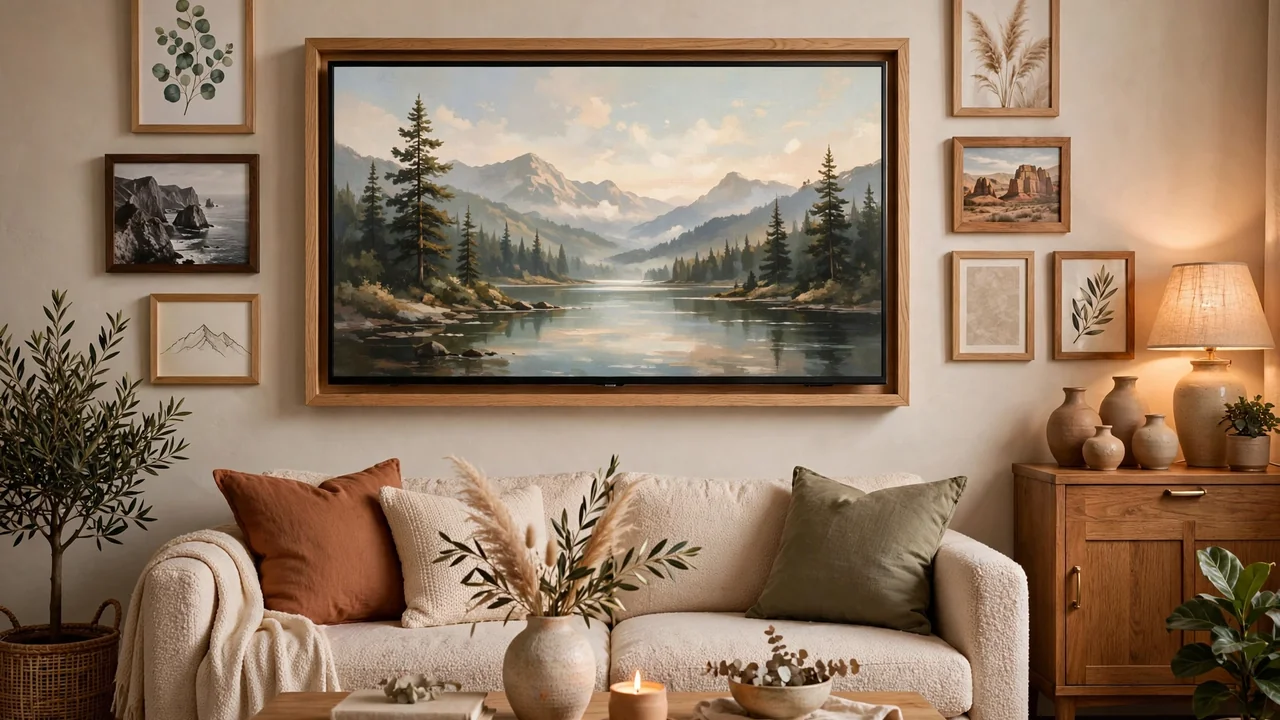
A gallery wall is the single best trick for making a TV feel like part of the decor instead of an intruder. When your screen is surrounded by framed art, photos, and prints, the eye reads the whole wall as one curated composition — and the TV just becomes the biggest frame in the arrangement. This works beautifully on a blank wall with no fireplace or architectural focal point.
Start by hanging the TV first at the correct height (more on that below), then build your art around it, keeping roughly 2 to 3 inches between the TV edges and the nearest frames. Mix frame styles for a collected feel — thin black frames, natural wood, one or two brass — but keep the art itself in a loose color palette so it hangs together. Include a variety of sizes: one large piece above or beside the TV, mediums flanking it, smalls filling gaps. Before hammering a single nail, lay everything out on the floor or tape paper templates to the wall. The result feels warm, personal, and effortlessly intentional.
2. Float a Sleek Media Console Beneath It
A floating media console — one that mounts to the wall with open space beneath — instantly makes a TV wall look lighter, more modern, and more spacious. That sliver of visible floor underneath tricks the eye into reading the room as bigger, which is gold in smaller living rooms. Choose a console that is wider than your TV by at least 6 to 12 inches on each side so the proportions feel balanced rather than top-heavy.
Style the top of the console simply: a low stack of coffee-table books on one end, a small trailing plant on the other, and maybe a sculptural object in the middle. Inside, hide remotes, game controllers, and streaming boxes behind closed doors or in woven baskets — clutter is the enemy of a styled TV wall. For cable management, run cords straight down behind the console into a paintable cord cover that blends into the wall. The whole look is clean, calm, and gallery-like.
3. Add Warm Wood Slats Behind the Screen
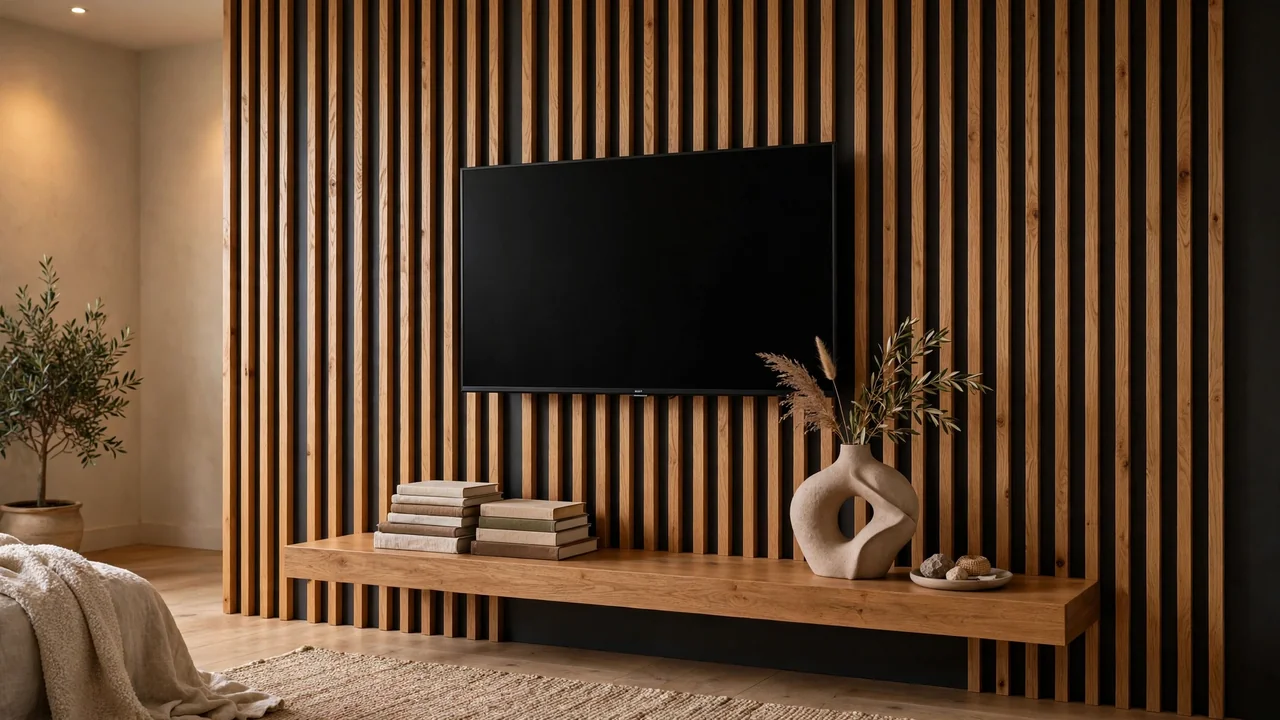
Vertical wood slats behind a TV add texture, warmth, and a designer look without much effort. The rhythmic lines draw the eye upward, making ceilings feel taller, and the natural wood tone softens the hard black rectangle of the screen. This is a favorite for modern farmhouse, Japandi, and organic-modern living rooms. Light oak or warm walnut tones work best; avoid anything too orange.
You can buy ready-made slat panels that install with construction adhesive or screws, or build your own with thin wood strips spaced about half an inch apart over a painted backing board. Paint the wall behind the slats a shade darker than the slats themselves — deep charcoal behind oak slats looks stunning. Mount the TV on an articulating arm attached through the slats into wall studs, keeping the screen center at seated eye level, roughly 42 inches from the floor. Leave a small gap between the slat panel and the ceiling so the installation looks intentional, not accidental.
4. Frame the TV With Built-In Cabinetry
Nothing makes a TV look more "meant to be there" than cabinetry that wraps around it. Flanking bookcases or a full built-in wall unit turn the TV into one element of a larger composition, and the shelves give you prime styling real estate. This is the most polished, high-end look on this list — and it adds serious storage.
If custom built-ins are out of reach, the classic shortcut is a pair of tall bookcases (about 72 inches tall works with most TVs) flanking a media console, bridged with a shelf above the TV. Paint everything — bookcases, console, and the wall section behind the TV — the same color for a seamless built-in effect; deep green, navy, or warm greige all look incredible. Style the shelves with a mix of books (some vertical, some stacked), ceramics, and small plants, leaving breathing room between objects. Mount the TV so its center sits around 42 inches high, aligned with the middle shelf line for a balanced look.
5. Paint the Wall Dark So the TV Disappears
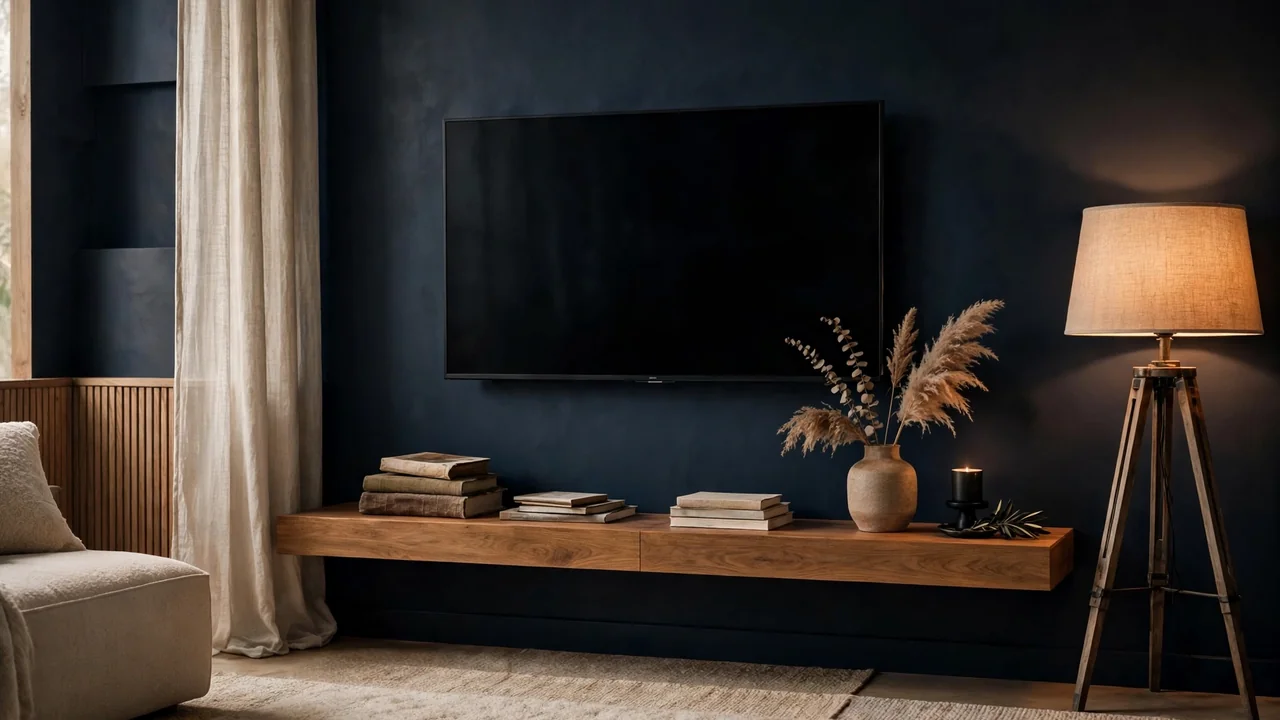
The simplest TV wall idea is also one of the most effective: paint the wall behind your TV a dark, rich color. When the screen is off, a black rectangle on a dark navy, charcoal, or forest-green wall practically vanishes — no more glowing void dominating the room. When it is on, the dark backdrop makes colors pop and reduces the glare around the screen edges.
This trick works in any style, from moody modern to classic traditional. Choose a paint with an eggshell or matte finish to avoid reflections, and carry the color across the whole wall (not just behind the TV) so it reads as a design choice. Balance the drama with lighter elements: a cream or natural-wood console, a soft beige rug, and warm lighting like a floor lamp with a linen shade. If a full dark wall feels like too much commitment, paint just a large rectangle or arch behind the TV for the same disappearing effect with less paint. Your TV will never look bulky again.
6. Mount Above the Fireplace (the Right Way)
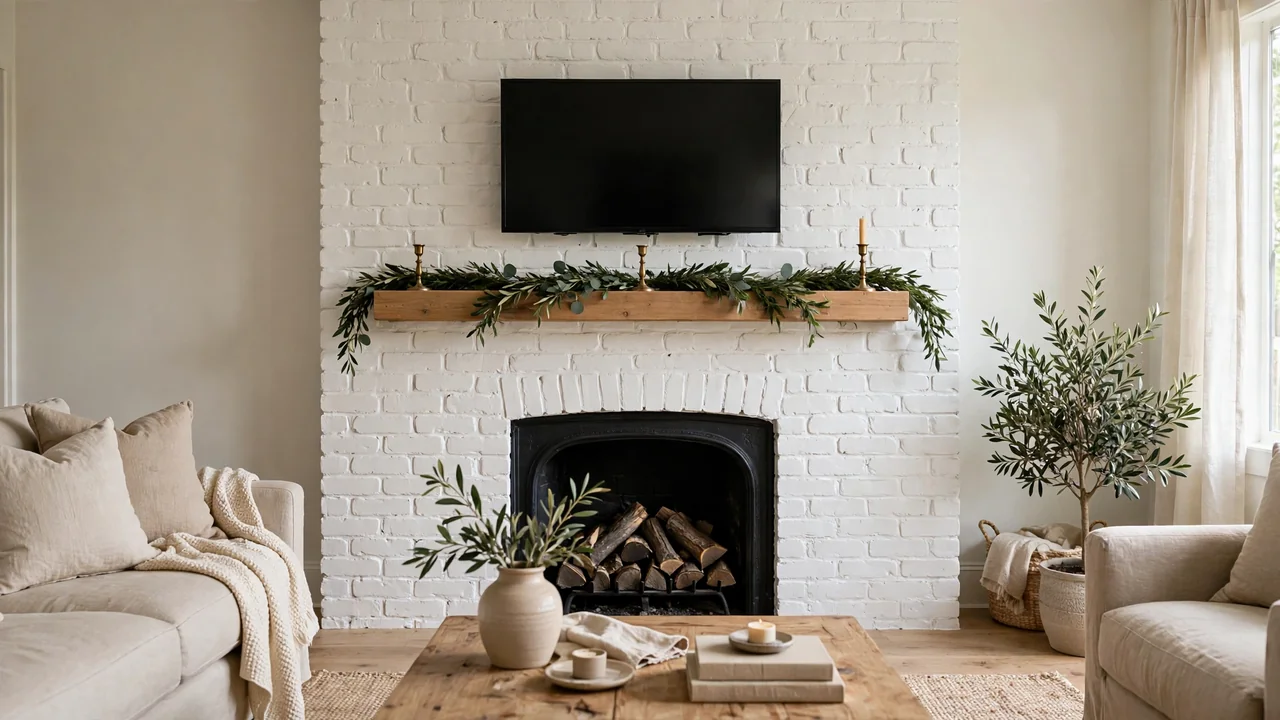
Mounting a TV above the fireplace is the most common TV wall setup — and the most commonly done too high. Fireplaces already sit high, and stacking a TV on top can push the screen center to 55 or 60 inches, leaving you craning your neck. If this is your layout, choose the lowest-profile mount possible and tilt the TV slightly downward toward the seating.
Aim to keep the bottom of the TV no more than 6 to 8 inches above the mantel, and if your mantel is unusually tall, consider lowering the mantel shelf itself. Heat is the other concern: if your fireplace puts out real warmth, mount a mantel shelf deep enough (at least 8 inches) to deflect heat away from the screen, and check your TV's clearance recommendations. Style the mantel with low-profile decor — a low garland of greenery, small brass candlesticks, a stack of art books — nothing tall enough to block the screen's bottom edge. A slim soundbar mounted just under the TV completes the setup without cluttering the mantel.
7. Hide Every Cable for a Clean Look
Visible cables are what separate a styled TV wall from a "we just plugged it in" TV wall. The fix is easier than most people think. For wall-mounted TVs, paintable cord covers (also called raceways) are the quickest win: snap the cables inside, stick the channel to the wall, paint it your wall color, and the cords disappear. Run the channel straight down from the TV to the console or floor for the cleanest line.
For a truly invisible result, use an in-wall cable kit with a power bridge — these let you route HDMI and power cables inside the drywall from behind the TV to behind the console, with code-compliant outlets at both ends. They install with a drywall saw and take most people under an hour. Do not forget the small stuff: use short cables (a 3-foot HDMI beats a coiled 10-footer), bundle extras with velcro ties instead of zip ties, and plug everything into a slim surge protector hidden inside the console. A tidy back-of-TV is the invisible detail that makes everything look professional.
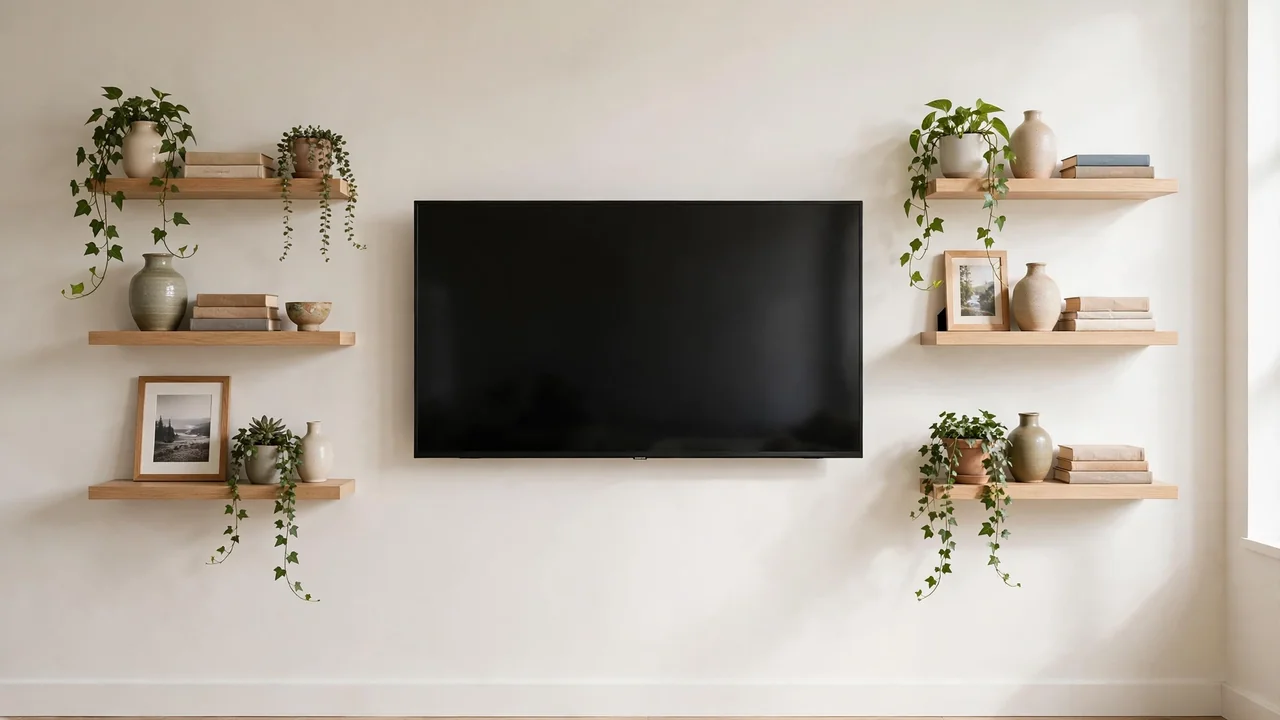
8. Flank the TV With Floating Shelves
Floating shelves on either side of (or above) the TV add balance, personality, and storage without the bulk of bookcases. This is the perfect middle ground between bulky built-ins and a bare wall. Two or three short shelves stacked on each side of the TV create a pleasing symmetrical frame; a single long shelf above the TV works when the screen sits low over a console.
Style shelves with the rule of thirds in mind: group objects in odd numbers, vary heights, and leave about a third of each shelf empty so it breathes. Good companions include small potted plants (trailing pothos softens hard edges beautifully), a few favorite books, ceramic vases, and one or two framed photos. Keep the shelf color close to your wall color for a subtle look, or go bold with dark walnut shelves on a light wall for contrast. Mount the TV first at eye-level height — screen center around 42 inches from the floor — then position shelves so their center lines feel aligned with the screen, not fighting it.
9. Style It Asymmetrical and Organic
Not every TV wall needs to be perfectly symmetrical. An off-center, organic arrangement can feel more relaxed and collected — ideal for bohemian, eclectic, or casual modern rooms. Hang the TV slightly left or right of center on the wall (or let it sit off-center above a longer console), then balance it with a tall plant, a floor lamp, or a leaning floor mirror on the heavier side.
The trick to asymmetry is visual weight, not matching pairs. A large fiddle-leaf fig or olive tree in a woven basket balances a 55-inch TV beautifully; a tall arc floor lamp does the same with a sculptural silhouette. On the console below, style in a loose triangle: a tall vase with pampas grass or branches on one end, a low stack of books in the middle, a small candle cluster on the other end. Keep a consistent color thread — say, warm woods and cream tones — running through the plant pot, books, and vase so the asymmetry feels curated rather than random. This look is forgiving and easy to refresh seasonally.
10. Create a Recessed TV Niche
If you are renovating or building a feature wall anyway, a recessed niche for the TV is the ultimate clean look. Setting the screen back into the wall — even just 3 to 4 inches — eliminates the floating-black-box effect entirely and makes the TV feel like part of the architecture. Frame the niche with trim, shiplap, or stone for a finished edge.
The niche should be sized generously: at least 4 to 6 inches wider than the TV on each side and a few inches taller, so the screen never looks crammed in. This breathing room also leaves space for ventilation, which electronics need. Paint the inside of the niche a shade darker than the surrounding wall for depth, and consider adding a slim LED strip along the niche's top edge — the soft backlight makes the TV look like it is floating and is wonderful for evening viewing. Because the TV sits at a fixed depth, choose a full-motion mount before closing up the wall so you can still pull the screen out for cable access later.
11. Let the TV Double as Art
When the TV is off, most screens are just a black void — but many modern TVs have an ambient or art mode that displays paintings, photography, or calming landscapes when idle. If yours does, treat the screen like a real piece of art: choose slow-changing landscape photography or classic paintings that match your room's palette, and set the brightness low so it reads as a print, not a billboard.
To sell the illusion, frame the TV with an actual frame. Slim magnetic or snap-on frames made for flat screens come in wood, black, and brass finishes and take minutes to attach — suddenly your TV looks like a genuine framed canvas on the wall. Hang it at art height (center around 57 inches is standard for artwork, though for comfortable viewing most people prefer the screen center closer to 42 inches — split the difference based on how often you watch versus how often you admire). Surround it with smaller real frames in a gallery arrangement, and guests will genuinely do a double-take when movie night begins.
12. Add Board-and-Batten or Picture-Frame Molding
Architectural molding is a classic way to make a TV wall feel finished and expensive. Board-and-batten strips or picture-frame molding boxes create rhythm and shadow lines that turn a flat wall into a feature — and the TV nestles right into the design like it was always meant to be there. This suits traditional, transitional, and modern farmhouse rooms especially well.
Plan your molding layout on paper first, with the TV as the centerpiece: a large molding rectangle framing the TV itself, flanked by matching rectangles, looks intentional and balanced. Use paint-grade trim boards about 3 inches wide, attached with brad nails and caulked at the seams, then paint the entire wall — molding and all — one color. Crisp white molding on a soft greige wall is timeless; going bold with the whole wall in deep green or navy makes the TV vanish into the design. Keep the molding pattern simple behind the screen (busy grids can peek out awkwardly around the TV edges) and save the fancier layouts for the wall sections beside it.
13. The Small Living Room TV Wall
Small living rooms need a TV wall that works hard without eating floor space. The winning formula: wall-mount the TV, choose a narrow console or floating shelf as the base, and keep the surrounding wall light and simple. A TV that is too large overwhelms a small room, so size the screen to your seating distance — roughly one inch of diagonal per 1.2 inches of viewing distance works well.
Mount the TV with the screen center at seated eye level, about 42 inches from the floor — in a small room you sit closer, so correct height matters even more. Choose a low-profile tilt mount so the TV hugs the wall; every inch of depth you save makes the room feel airier. Below, a slim console (12 to 14 inches deep) holds the essentials without jutting into the walkway. Keep the wall color light — soft white, warm greige, pale sage — plus one vertical accent, like a tall narrow plant or leaning floor lamp, to draw the eye up. Breathing room is what makes small spaces feel calm.
14. Make a Corner TV Setup Work
Corner placement is common in awkward living rooms — and it can look great with the right treatment. The key is anchoring the TV so it does not look like it drifted there by accident. A corner console (triangular or angled) fills the dead space behind the screen and gives the setup a deliberate footprint; if you already own a rectangular console, pull it into the corner at an angle with the TV above it.
Mount the TV on a full-motion arm anchored into a corner stud so you can angle the screen toward the seating — and push it flat when not in use. Dress both wall sections with intention: a tall plant on one side, a floor lamp on the other, or matching art prints framing the corner symmetrically. Keep cables extra tidy here, since corner setups show cords from multiple angles — an in-wall kit or well-painted cord cover is worth the effort. A round rug centered on the seating area (rather than the TV) helps the whole arrangement feel grounded.
15. Style the Console Top Like a Pro
The surface under your TV is prime styling real estate — treat it like a mantel. The goal is a layered, collected look that frames the screen without competing with it. Work in odd-numbered groupings and vary heights: a tall vase with branches on one side, a stack of books with a small object on top in the middle, a low bowl or candle cluster on the other side. This high-low-high rhythm keeps the eye moving pleasantly.
Keep everything below the bottom edge of the TV screen — nothing should creep up and block the picture. Choose decor that echoes your room's palette: ceramic vases in warm neutrals, linen-covered design books, a trailing plant softening one corner. A table lamp on the console adds warm, low light for evening viewing; place it off to the side so it does not fight the screen for attention. Finally, leave some empty surface — negative space is what separates "styled" from "cluttered." Step back, squint, and remove one thing. That is usually the perfect amount.
Styling Tips
– Mount at eye level. The golden rule: the center of your TV screen should sit at seated eye level, about 42 inches from the floor for most sofas. Measure your eye height while sitting on your own couch — that is your target, not a number from a box.
– Size the TV to the wall, not the room. A TV should occupy roughly two-thirds of the wall or console width beneath it. Too small looks lost; too big dominates everything. When in doubt, tape the dimensions on the wall with painter's tape and live with it for a day.
– Mind the viewing distance. Sit 1.5 to 2.5 times the screen's diagonal measurement away. A 55-inch TV wants roughly 7 to 11 feet; a 65-inch wants 8 to 13 feet. Closer than that and you will see pixels; farther and you lose the cinematic feel.
– Hide cables before you style. Do all cord management — raceways, in-wall kits, short cables — before placing a single decorative object. It is ten times harder to tidy cables around styled shelves than behind an empty wall.
– Balance the black box. A TV is a big dark rectangle, so surround it with warmth: wood tones, soft textiles, greenery, and warm lighting. These keep the wall from feeling cold and techy.
– Use bias lighting. A soft LED strip behind the TV reduces eye strain in dark rooms and makes the screen look like it floats. Choose a warm white (around 2700–3000K) rather than harsh blue-white.
– Keep the remote clutter contained. A small lidded box or woven basket on the console corrals remotes, controllers, and chargers. Nothing ruins a styled TV wall faster than a tangle of remotes.
– Check the glare. Before finalizing placement, sit in your usual spot at different times of day and look for window reflections on the screen. An anti-glare screen protector or repositioned curtains solve most glare problems cheaply.
FAQ
How high should I mount my TV on the wall?
Mount it so the center of the screen sits at your seated eye level — for most sofas, that is about 42 inches from the floor to the middle of the screen. Sit on your couch, have someone measure from the floor to your eyes, and use that number as your target. Mounting too high is the most common mistake and the main cause of neck strain during movie nights. Above a fireplace, keep the bottom of the TV within 6 to 8 inches of the mantel and tilt the screen slightly downward.
How can I hide the cables behind my TV?
You have three good options. Paintable cord covers are the fastest: snap cables inside a slim channel, stick it to the wall, and paint it to match. An in-wall cable kit routes power and HDMI through the drywall for a completely invisible look — most install in under an hour with a drywall saw. The third option is furniture: a console with a hollow back or cable cutouts swallows cords, especially when paired with short cables and velcro ties instead of long, coiled ones.
Is it bad to mount a TV above the fireplace?
It is not bad, but it comes with two trade-offs: height and heat. Fireplaces push TVs higher than the ideal 42-inch screen center, which can strain your neck — use the slimmest mount possible, keep the gap above the mantel small, and tilt the screen down. For heat, make sure your mantel shelf is deep enough to deflect warmth away from the screen, and check your TV manufacturer's clearance guidelines. If your mantel is very tall, consider whether a different wall would be more comfortable for daily viewing.
What size TV should I get for my living room?
Use your seating distance as the guide: sit about 1.5 to 2.5 times the screen's diagonal away from the TV. Measure from your sofa to the wall in inches and divide by 2 to find a comfortable screen size in the middle of that range. Also check proportions — the TV should span roughly two-thirds of the width of the wall section or console beneath it. In small rooms, resist going oversized; a screen that is too large for the space feels overwhelming rather than cinematic.
How do I make my TV blend in with my decor?
Paint the wall behind it a dark color so the black screen disappears when off. Surround it with a gallery wall so it reads as one frame among many. Use your TV's art or ambient mode to display artwork when idle, and add a slim snap-on frame in wood or brass so it looks like a real canvas. Flanking the TV with bookshelves or styling a warm, layered console beneath it also shifts the eye from "screen" to "styled wall."
Should the TV be centered on the wall?
Centered is classic and calming, especially with symmetrical shelving or art on both sides. But off-center can look fantastic too — try placing the TV slightly left or right and balancing it with a tall plant, floor lamp, or leaning mirror on the opposite side. The key is visual weight: whatever sits opposite the TV should feel roughly as substantial. Either way, keep the screen center at seated eye level (about 42 inches) regardless of horizontal position.
Conclusion
Your TV wall does not have to be the design compromise of your living room. With the right mounting height — screen center at seated eye level, around 42 inches — plus a thoughtful console, hidden cables, and a few well-chosen styling touches, that big black rectangle becomes a genuine focal point. Whether you go for a cozy gallery wall, warm wood slats, or a dramatic dark backdrop, the best TV wall is the one that feels like it belongs in your room. Pick the idea that fits your space, grab your measuring tape, and enjoy every movie night a little more.