
15 Kitchen Pantry Ideas
A pantry is so much more than a place to stash cereal boxes and canned soup. It's the quiet backbone of a kitchen that works — and when it looks good, the whole kitchen feels calmer, more inviting, and more yours. Whether you have a tiny cabinet corner, a generous walk-in, or nothing more than an awkward closet to work with, there's a pantry style here for you.
In this roundup, we're exploring 15 kitchen pantry ideas covering layouts, doors, colors, lighting, and small-space tricks. From glass-door showcases that put your prettiest jars on display to hidden pantry doors that look like shiplap paneling, each idea comes with practical styling details you can actually use. Save this post, pin your favorites, and get ready to fall in love with the most hardworking corner of your home.

1. Classic White Shaker Pantry Cabinets
White shaker-style pantry cabinets are the forever-favorite for a reason: they keep food storage looking as polished as the rest of the kitchen. Choose full-height cabinetry with deep pull-out drawers on the lower half and open shelving up top — that combination gives you hidden storage for appliances plus easy-grab access to everyday items. Add oil-rubbed bronze or matte black cup pulls for contrast, and run the same crown molding across the top that your kitchen cabinets have so the pantry reads as one built-in unit. Inside, paint the back of the cabinet a soft sage or warm greige to add depth without committing to color on the outside. Line shelves with woven seagrass baskets for snacks and a few glass canisters for staples like rice and flour. The result is crisp, calm, and endlessly re-styleable — just swap the baskets and canisters when you want a fresh feel.
2. Glass-Door Display Pantry
If your pantry contents are pretty, put them on show. Glass-front pantry doors turn everyday storage into a styled display — think rows of uniform glass jars filled with pasta, grains, and baking supplies, punctuated by wooden cutting boards and a small trailing plant on the top shelf. Choose reeded or fluted glass if you want the curated look with a little forgiveness; it blurs the clutter while still glowing softly when the under-shelf lighting is on. Keep the inside palette tight: three materials max (glass, wood, and one basket texture) so it reads intentional rather than busy. For a renter-friendly version, skip the built-in entirely and style a tall glass-door cabinet from a thrift store in a kitchen corner, anchoring it with a small rug. The trick to making this work long-term is decanting — once dry goods leave their boxes, everything suddenly photographs beautifully.
3. Sliding Barn Door Pantry
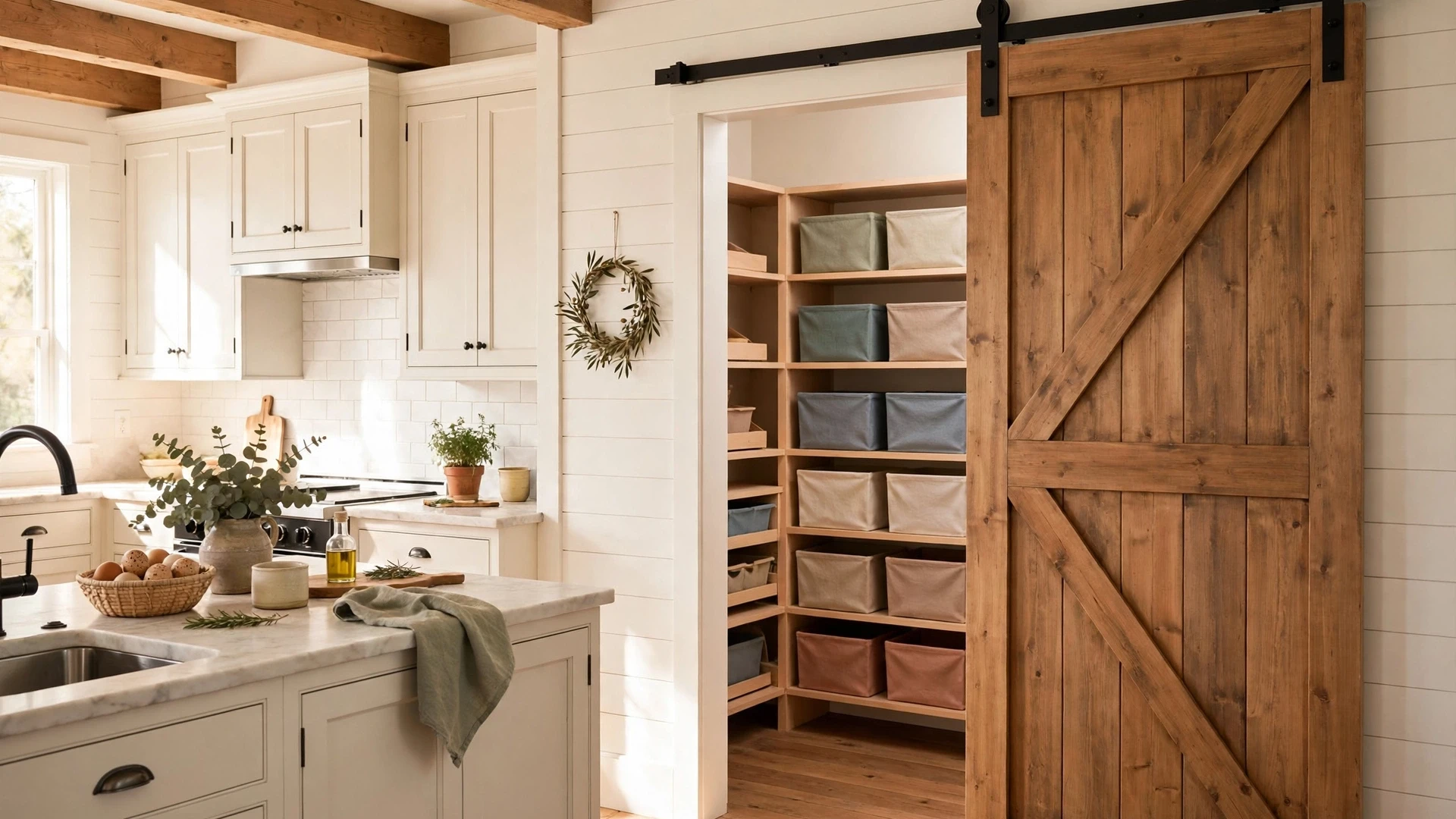
A sliding barn door brings farmhouse charm and serious space savings, since nothing swings into your walkway. Mount a black metal track above the pantry opening and choose a door in a warm wood tone or painted a deep, moody green. Leave the shelves behind it simple — light wood or painted white — because the door itself is the star. To keep the interior tidy behind closed doors, use labeled pull-out bins on each shelf so every family member knows where things live. Add a soft-close mechanism so the door glides quietly (worth it in open-plan homes), and consider a door with a chalkboard or magnetic panel for grocery lists and menus. Style the wall beside the door with a small piece of art or a wreath for seasonal changes. This look works especially well in farmhouse, cottage, and rustic-modern kitchens where texture and warmth carry the design.
4. Arched Pantry Doorway
There's something undeniably romantic about an arched pantry opening — it softens a boxy kitchen and instantly adds architectural interest. If your pantry is open or you want to leave it doorless, frame the entrance with a painted arch in a warm limewash or Venetian plaster finish for an old-world, Mediterranean feel. Paint it a shade darker than the surrounding walls so the shape reads clearly. Inside, lean into the romance: rounded woven baskets, arched-top canisters, and a small vintage-style stool for reaching high shelves. Hang a warm pendant or a small brass sconce just inside the arch so the pantry glows invitingly at night. For renters, a peel-and-stick arch mural around a plain closet opening captures most of the magic with zero construction. Pair the curve with soft, warm neutrals inside — honey-toned wood, cream ceramics, and linen tones — and the whole corner will feel like a tiny escape.
5. Walk-In Pantry with L-Shape Shelving
L-shaped shelving is the most efficient way to maximize a walk-in pantry, using two walls instead of one and leaving the center free for a small step stool or a rolling cart. Plan your zones deliberately: tall items and small appliances on the bottom shelves, everyday cooking ingredients at eye level, and bulk or seasonal items up high. Keep shelf depth to about 14 inches on one wall for cans and jars, and 16–18 inches on the other for larger items like cereal boxes and the stand mixer. Paint the walls a light, warm white so nothing disappears into shadows, and add battery-powered puck lights or an LED strip under each shelf — good lighting is the single biggest upgrade a pantry can get. Finish with a mix of clear stackable bins for bulk goods, matching baskets for snack categories, and one decorative moment: a framed print, a small potted herb, or a pretty clock. When every shelf has a job, restocking becomes almost automatic.
6. Corner Pantry Cabinet with Lazy Susan
Awkward kitchen corners are pantry gold in disguise. A corner pantry cabinet with a lazy Susan turntable solves the classic problem of items vanishing into the back of deep shelves. Choose a cabinet with at least two rotating tiers, and corral items into shallow, handled bins on each tier so nothing topples when it spins. Dedicate one tier to oils, vinegars, and sauces and the other to spices and baking essentials — grouping by cooking task means you grab one bin and go. Paint or stain the cabinet to match your kitchen so it blends in, and add interior lighting on a motion sensor for that little thrill of discovery. On top of the cabinet, style a small vignette: a wooden tray with your prettiest olive oil, a ceramic garlic keeper, and a sprig of dried eucalyptus. It's proof that the humblest corner can be both beautiful and brilliantly functional.
7. Pantry Nook with Open Shelving
No dedicated closet? Claim a nook. A stretch of open shelving along one kitchen wall — even just 24 inches wide — becomes a charming pantry nook with the right styling. Install three to four chunky floating shelves in white oak or painted to match the walls, and treat them like a curated display: everyday dishes and glasses on the lowest shelf, decanted dry goods in glass jars in the middle, and decorative pieces (a vintage scale, woven baskets, trailing pothos) up top. The secret to open shelving that stays pretty is rhythm — alternate tall and short items, repeat two or three materials, and leave some breathing room between groupings. Add a slim picture light or clip-on spot above the top shelf to make it glow in the evening. Corral cooking oils and frequently used sauces on a wooden tray so they look styled instead of scattered. This approach costs very little and brings an airy, European-café feel to any kitchen.
8. Moody Dark-Green Pantry
For a pantry with drama and personality, go dark. Deep forest or emerald green pantry walls or cabinetry create a jewel-box effect that makes brass hardware, warm wood, and glass jars absolutely glow. If painting the whole pantry feels bold, try it on the inside of the doors and the back wall of open shelves first — you get the impact every time you open up, without committing the whole room. Style with warm metals (brass or aged gold pulls and hooks), amber glass containers, and wooden crates or boxes for texture. Add warm-toned lighting — 2700K LEDs or a small vintage-style bulb — because cool light fights the coziness dark green wants. A dark pantry photographs beautifully, so lean into it: arrange items in color groups, keep labels minimal and elegant, and add one sculptural element like a ceramic vase or a brass bowl. It's the pantry equivalent of a little black dress — timeless with an edge.

9. Hidden Pantry Door (Secret Door Style)
Few kitchen features delight guests like a pantry door disguised as something else — a floor-to-ceiling bookshelf, a shiplap accent wall, or a paneled cabinet front that swings open with a push. The key is seamless detailing: no visible handle (use a magnetic touch latch), consistent trim profiles, and hinges hidden on the inside. Inside, the surprise continues — paint the interior a soft, cheerful color or add wallpaper in a fun pattern so opening the door feels like stepping into a little secret. Because hidden doors are flush, keep the pantry interior streamlined: uniform containers, slim-profile shelves, and everything labeled so the reveal is beautiful, not chaotic. This works best when the surrounding wall treatment is already substantial — full shiplap, board-and-batten, or a tall built-in bookcase — so the door genuinely disappears. It's part storage, part conversation piece, and entirely worth the extra carpentry.
10. Pull-Out Pantry Tower
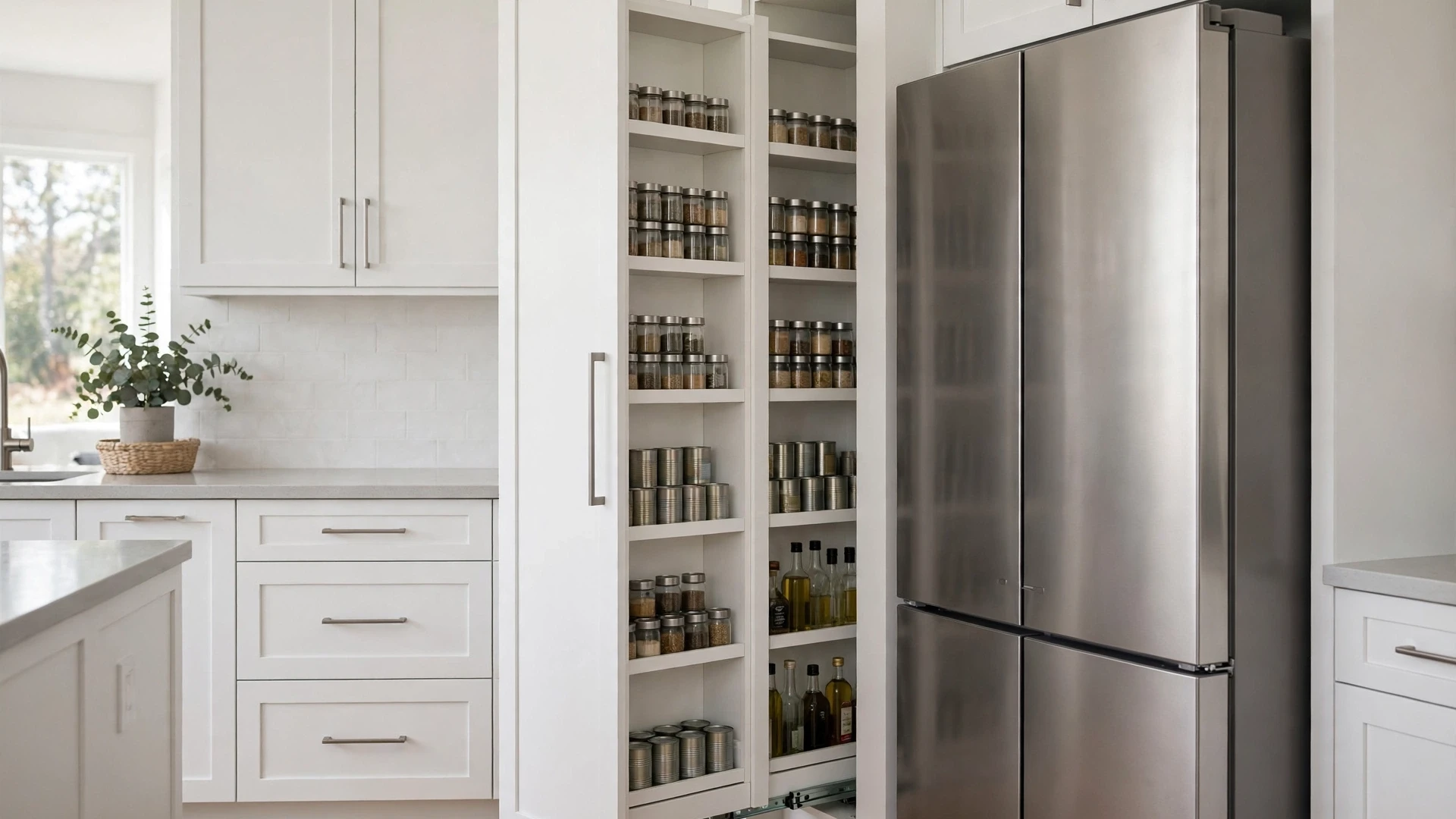
The pull-out pantry tower is the space-saving hero for narrow gaps — those 6-to-12-inch slivers beside the fridge or range that would otherwise go to waste. A tall, narrow unit on smooth full-extension slides pulls straight out to reveal stacked shelves on both sides, putting every can and spice jar within reach. Organize by height: spices and small jars up top, cans and bottles in the middle, and taller items like cereal boxes and oils at the bottom. Choose shelves with raised rails or add small acrylic guards so nothing slides off when you pull the unit out with enthusiasm. Label the front of each shelf if you share the kitchen — "baking," "canned goods," "snacks" — so restocking is a family affair. Finish the visible face to match your cabinetry with a matching pull handle, and the tower disappears into the kitchen run. It's one of the highest-impact-per-inch upgrades you can make.
11. Pantry with a Coffee and Tea Station
Give your pantry a job beyond storage by carving out a dedicated coffee and tea station — a single shelf or a small counter run where the morning ritual lives. Install a shelf at counter height with an outlet behind it for the coffee maker, kettle, or espresso machine, and style the shelves above with mugs on hooks, a tea caddy collection, and glass jars of beans and loose-leaf tea. Add a small tray to catch drips and corral sugar, spoons, and filters into one pretty container. Warm under-shelf lighting makes the station glow invitingly before sunrise, and a small framed print or chalkboard with a favorite quote adds personality. If the pantry is separate from the main kitchen, this setup keeps morning traffic out of the cook's way — a genuine workflow upgrade. Keep the palette warm and cozy: wood, cream ceramics, and brass accents. Your future half-awake self will thank you.

12. Two-Tone Pantry: Wood and White
Two-tone design brings warmth to a pantry without going fully rustic: pair crisp white shelving or cabinetry with natural wood accents — butcher-block countertops, oak shelf fronts, or a warm wood door. The white keeps everything bright and clean-looking (crucial in a small, windowless pantry), while the wood adds the organic texture that makes a space feel loved rather than sterile. Try white upper shelving with a wood countertop below for a prep-and-decant zone, or white cabinets flanking a central wood hutch styled with cookbooks and ceramics. Repeat the wood tone two or three times — door, countertop, and a stool or crate — so it feels deliberate. Style shelves with a mix of white ceramics, clear glass, and one or two woven baskets to echo the wood's warmth. This combination works in nearly every kitchen style, from modern farmhouse to Scandinavian to transitional, and it ages gracefully.
13. Pantry with Chalkboard or Label Wall
A chalkboard wall or a gallery of pretty labels turns pantry organization into decor. Paint one interior wall (or the back of the door) with chalkboard paint and use it for a running grocery list, a meal plan, or sweet hand-lettered category names — "grains," "baking," "snacks." If you prefer a cleaner look, invest in a label maker or pre-made minimalist labels for every jar, bin, and basket; matching labels are the fastest way to make mixed containers look like a designed set. Take it one step further with framed printable art — a vintage produce chart, a coffee illustration, a simple botanical — hung on any free wall space. Keep the color scheme of labels and art consistent (black and kraft, or white and sage) for a collected-not-cluttered feel. This idea shines in family kitchens, where clear labels mean kids and partners can actually put groceries away in the right spot.
14. Small-Space Pantry: Over-the-Door and Vertical Storage
When square footage is scarce, think vertical. An over-the-door organizer on the pantry door (or any nearby door) adds instant shelving for spices, packets, and wraps without touching floor space — choose a slim wire or wood version in a finish that matches your kitchen. Inside the pantry, go up: extend shelving to the ceiling for rarely used items, add stackable risers so cans form stadium rows you can actually see, and mount slim racks on the inside of the door for flat items like cutting boards and baking sheets. A rolling narrow cart that tucks into a gap beside the fridge works as a bonus mini-pantry for oils and condiments. Decant aggressively — boxes and bags waste up to 30% of shelf space — and use square containers rather than round ones, since squares pack together with no wasted gaps. Small pantries reward ruthless editing: if you haven't used it in three months, it doesn't earn a shelf.
15. Pantry with a Window or Natural Light
If you're lucky enough to have a window in or near your pantry, design around it — natural light is the most flattering pantry accessory there is. Place a small counter or a wide shelf beneath the window as a potting-style prep spot for decanting bulk goods, and use the sill for a row of small potted herbs (basil, thyme, mint) that double as cooking ingredients and living decor. Keep window treatments simple: a cafe curtain or a woven shade that filters light without blocking it. Style the sunlit shelves with glass and ceramic in light, reflective tones — honey, cream, pale green — so the light bounces around. Avoid storing anything light-sensitive (like olive oil or certain spices) right in the sun's path; keep those in opaque containers or on lower, shaded shelves. Even a pantry that only borrows light from an adjacent window feels bigger and more pleasant — so if your pantry opens off a bright hallway or kitchen, leave the door open or swap it for glass to invite that glow in.
Styling Tips
Start with a ruthless edit. Before buying a single basket or jar, pull everything out, toss expired items, and donate duplicates — styling a cluttered pantry is like decorating around furniture you hate. Once you're down to what you actually use, group items by category (breakfast, baking, snacks, canned goods, cooking oils) and give every category a home before you shop for containers.
Decant dry goods into matching containers. Uniform jars and canisters are the single fastest way to make any pantry look designed. You don't need a full matching set on day one — start with your five most-used staples (flour, sugar, rice, pasta, coffee) and expand over time. Clear containers let you see levels at a glance; opaque ceramic or tinted glass looks sleeker but needs labels.
Light it well. Most pantries are under-lit, which makes even organized shelves feel gloomy. Battery-operated motion-sensor puck lights or stick-on LED strips under each shelf cost little and change everything — you'll actually see what you have, which means less duplicate buying and less food waste.
Use the door. The inside of a pantry door is free real estate: slim spice racks, a chalkboard for lists, hooks for aprons or reusable bags, or a narrow wire organizer for wraps and packets. In small pantries, door storage can add the equivalent of an entire shelf.
Label everything. Matching labels on jars, bins, and baskets make mixed containers look intentional and help everyone in the household put things back where they belong. Keep label wording short and consistent — "rice," "pasta," "snacks" — and place them at the same height on every container for a tidy, rhythmic look.
Leave breathing room. The prettiest pantries aren't packed to the brim. Leave a little empty space on each shelf and one shelf styled with something purely decorative — a small plant, a framed print, a pretty bowl. That negative space is what separates "storage" from "styled."
FAQ
How deep should pantry shelves be?
For most pantries, 12 to 16 inches is the sweet spot. Shallower shelves (12 inches) are ideal for cans, jars, and spices because nothing gets lost in the back. Go up to 16 or 18 inches only for zones holding large items like small appliances, cereal boxes, or bulk packages. Deeper than 18 inches, and you'll need pull-out drawers or bins to keep the back reachable.
What's the best way to organize a small pantry?
Zone by use, decant into square stackable containers, and go vertical. Group items into categories (breakfast, baking, snacks, dinner ingredients), use risers so back rows are visible, and claim the door with slim racks. Keep everyday items at eye level, heavy or rarely used items low or high, and be ruthless about expired or duplicate items — small pantries can't afford dead weight.
Should pantry doors be open or closed shelving?
It depends on your tolerance for maintenance. Open shelving looks airy and lets you show off pretty jars, but it demands consistent styling and regular dusting. Closed cabinetry hides the chaos and needs less upkeep, which suits busy households. A popular middle ground: glass-front doors, which give the display look with dust protection — especially with reeded glass that softens visual clutter.
How do I keep my pantry from looking cluttered?
Limit your palette to two or three materials (for example, clear glass, natural wood, and one basket weave), decant boxed goods into matching containers, and label consistently. Corral small items into bins so shelves read as a few large shapes rather than dozens of small ones, and leave some empty space on every shelf. Good lighting also helps — shadows make clutter look worse than it is.
Can I add a pantry if my kitchen doesn't have one?
Absolutely. A tall freestanding cabinet, a converted coat closet near the kitchen, a rolling cart tucked into a gap, or even a styled stretch of open wall shelving can all function as a pantry. The key is defining zones and using containers consistently — a "pantry" is really just organized food storage with a designated home, not a specific room.
What's the best lighting for a pantry?
Warm white (around 2700K–3000K) flatters food and makes the space feel inviting. LED strip lights under each shelf give the most even coverage, while motion-sensor puck lights are the easiest retrofit — no wiring needed. If your pantry has a door that's often closed, a motion sensor or door-jamb switch means the light is on exactly when you need it.
Conclusion
The best pantry isn't the biggest or the most expensive — it's the one that makes your daily cooking easier and a little more joyful. Whether you fell for the moody dark-green jewel box, the space-saving pull-out tower, or the simple charm of an open-shelf nook, pick the one or two ideas that fit your space and start there. A weekend, a few matching jars, and some good lighting are all it takes to transform the hardest-working corner of your kitchen. Pin your favorites, and happy organizing!