

Japandi Bathroom Design: 18 Calm East-Meets-Scandi Ideas
There is a particular kind of calm you feel when you step into a Japandi bathroom. The room is quiet without being empty, warm without being busy. Light wood softens the edges of clean stone, everything you need is within reach, and nothing you don’t need is in sight. It is the feeling of a small spa that somehow fits into everyday life — and it is exactly why japandi bathroom design has become one of the most loved bathroom styles of the last few years.
Japandi is the meeting point of Japanese minimalism and Scandinavian warmth. From Japan it takes restraint, craftsmanship, and a reverence for natural materials. From Scandinavia it takes coziness, light, and the belief that a home should be comfortable rather than precious. In a bathroom, these two philosophies blend beautifully: the room becomes simpler, calmer, and easier to keep clean, while never feeling cold or clinical.
This guide walks you through everything you need to create a Japandi bathroom of your own — the philosophy behind the style, the color palette, the materials that matter, fixtures, lighting, storage, and styling. Whether you are planning a full renovation or simply want to nudge your current bathroom toward a calmer look, you will find practical ideas you can use at any budget.
What Is Japandi Bathroom Design?
Before choosing tiles or taps, it helps to understand what makes Japandi different from plain minimalism or a standard modern bathroom. Japandi is not about having as little as possible. It is about having exactly the right things — chosen with care, made from honest materials, and arranged so the room breathes.
The Two Roots: Japanese and Scandinavian
The Japanese side of Japandi brings the philosophy of wabi-sabi — the appreciation of imperfection and the beauty of natural, aging materials. A handmade ceramic soap dish with a slightly uneven glaze, a wooden stool that will develop a patina over time, a stone basin that looks carved rather than manufactured: these are wabi-sabi touches. Japanese design also contributes the idea of the bathroom as a place of ritual. In Japan, bathing is not a rushed chore but a restorative daily practice, and the room is designed to honor that.
The Scandinavian side brings hygge — comfort, warmth, and light. Scandinavian bathrooms have long favored pale wood, soft textiles, and bright, airy spaces that make dark winters bearable. This warmth keeps Japandi from tipping into starkness. Where pure Japanese minimalism can feel austere, the Scandinavian influence adds folded towels in natural linen, a soft bath mat underfoot, and candlelight that makes an evening bath feel inviting.
Practical tip: When you are unsure whether a choice is “Japandi enough,” ask two questions: Is it simple and made from a natural material (the Japanese test)? And does it make the room feel warm and livable rather than like a showroom (the Scandinavian test)? If the answer to both is yes, it belongs.
Why Japandi Works So Well in Bathrooms
Bathrooms are the smallest, hardest-working rooms in the home. They collect clutter faster than any other space — bottles, tubes, cleaning products, laundry. Japandi’s emphasis on concealed storage and visual calm directly solves this problem. A Japandi bathroom is designed so that tidying is almost automatic, because everything has a home behind a cabinet door or inside a beautiful basket.
The style also suits the way we actually use bathrooms. Mornings need brightness and efficiency; evenings need softness and calm. The Japandi palette of warm neutrals and natural materials looks good in both harsh morning light and dim evening lamplight, and the style’s layered lighting approach lets you switch the mood of the room in seconds.
The Japandi Color Palette
Color is the foundation of the Japandi look. The palette is deliberately restrained: warm neutrals, soft whites, and muted earth tones, with contrast kept low and gentle. The goal is a room where no single surface shouts for attention, so the overall effect is one of quiet harmony.
Warm Neutrals as Your Base
Start with a base of warm whites, soft beiges, oatmeal, and light greige. These are the colors of natural materials — limewash, clay plaster, unbleached linen, pale timber — and they make the room feel larger and brighter without the coldness of pure white. Walls in a warm off-white with a hint of beige create a soft envelope that flatters both wood and stone.
For floors and larger surfaces, consider mid-tone neutrals: warm gray stone tiles, pale concrete-look porcelain, or light wood-look flooring. These ground the room and hide everyday wear better than very pale surfaces. Keep the undertones consistent — if your walls lean warm, your floor and fixtures should lean warm too. Mixing warm beige walls with cool blue-gray tiles is one of the fastest ways to break the Japandi spell.
Practical tip: Collect paint and tile samples and look at them together in your actual bathroom light, at different times of day. A color that looks like warm oatmeal in the shop can read pink or gray under your bathroom’s lighting. Live with the samples for a few days before committing.
Accent Colors That Keep It Calm
Japandi is not colorless — it simply uses color the way nature does, in muted, dusty tones. Sage green, clay, soft terracotta, warm taupe, and muted charcoal all work as accents. Use them sparingly: a sage-painted vanity, clay-colored towels, a charcoal bath mat, or a single wall in a muted earth tone.
A good rule of thumb is the 70-20-10 approach: roughly 70 percent warm neutrals, 20 percent natural wood tones, and 10 percent muted accent color. This keeps the room serene while giving the eye just enough interest. Plants count as accent color too — the green of a fern or eucalyptus stem is one of the easiest ways to add life to a neutral bathroom.
- Safe pairings: warm white + light oak + sage; beige + travertine + clay; greige + walnut + soft black.
- Use contrast gently: a dark bronze tap against a pale basin, or a charcoal stool beside a light wood vanity, adds definition without noise.
- Avoid: bright primaries, high-gloss saturated colors, and busy multi-color patterns — they fight the calm the style depends on.
Materials That Define Japandi Bathrooms
If color is the foundation of Japandi, materials are its soul. The style is built on honest, tactile surfaces — things you want to touch. Wood, stone, clay, linen, and bamboo appear again and again, and the way they age gracefully is part of the point.
Light Wood: The Heart of Japandi
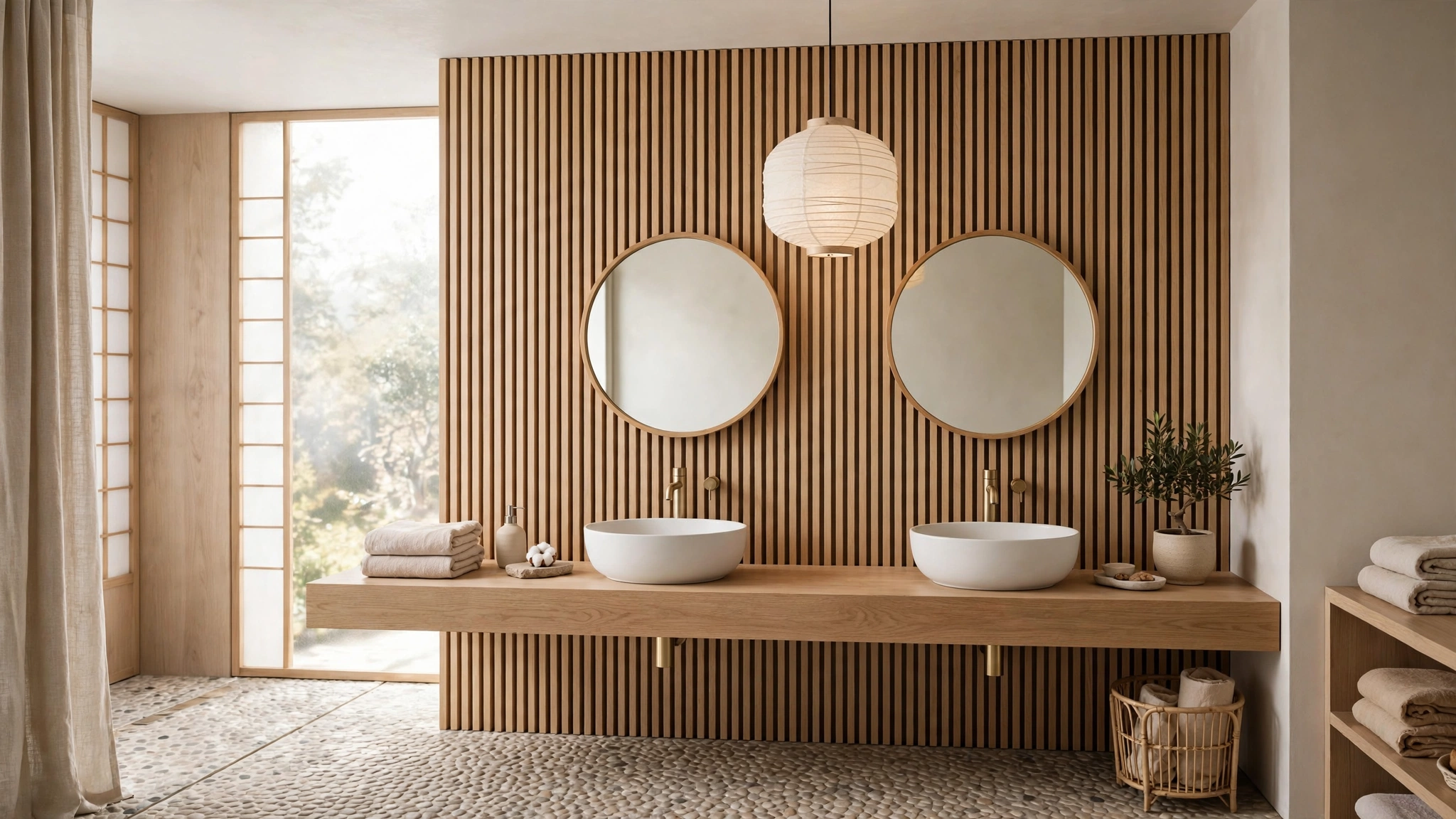
Light wood is the single most recognizable Japandi material. Think white oak, ash, beech, birch, and pale bamboo — woods with a soft grain and a honey-blonde tone rather than deep or reddish browns. Use wood where it will be seen and touched: a floating vanity, open shelving, a bath bridge across the tub, a stool, or a slatted accent wall.
In a wet environment, wood needs protection. Choose sealed or oiled finishes rated for bathrooms, keep wood away from direct constant water contact (a teak shower bench is fine; an unsealed wooden floor inside the shower is not), and make sure the room is well ventilated. Engineered wood vanities with a quality oak veneer give you the look with better moisture resistance than solid timber, and wood-look porcelain tiles can bring warmth to floors with zero maintenance worries.
Practical tip: Limit yourself to one or two wood tones in the room. A light oak vanity plus a slightly deeper walnut stool can work, but three or four competing wood finishes will make the space feel busy rather than calm.
Natural Stone and Textured Surfaces
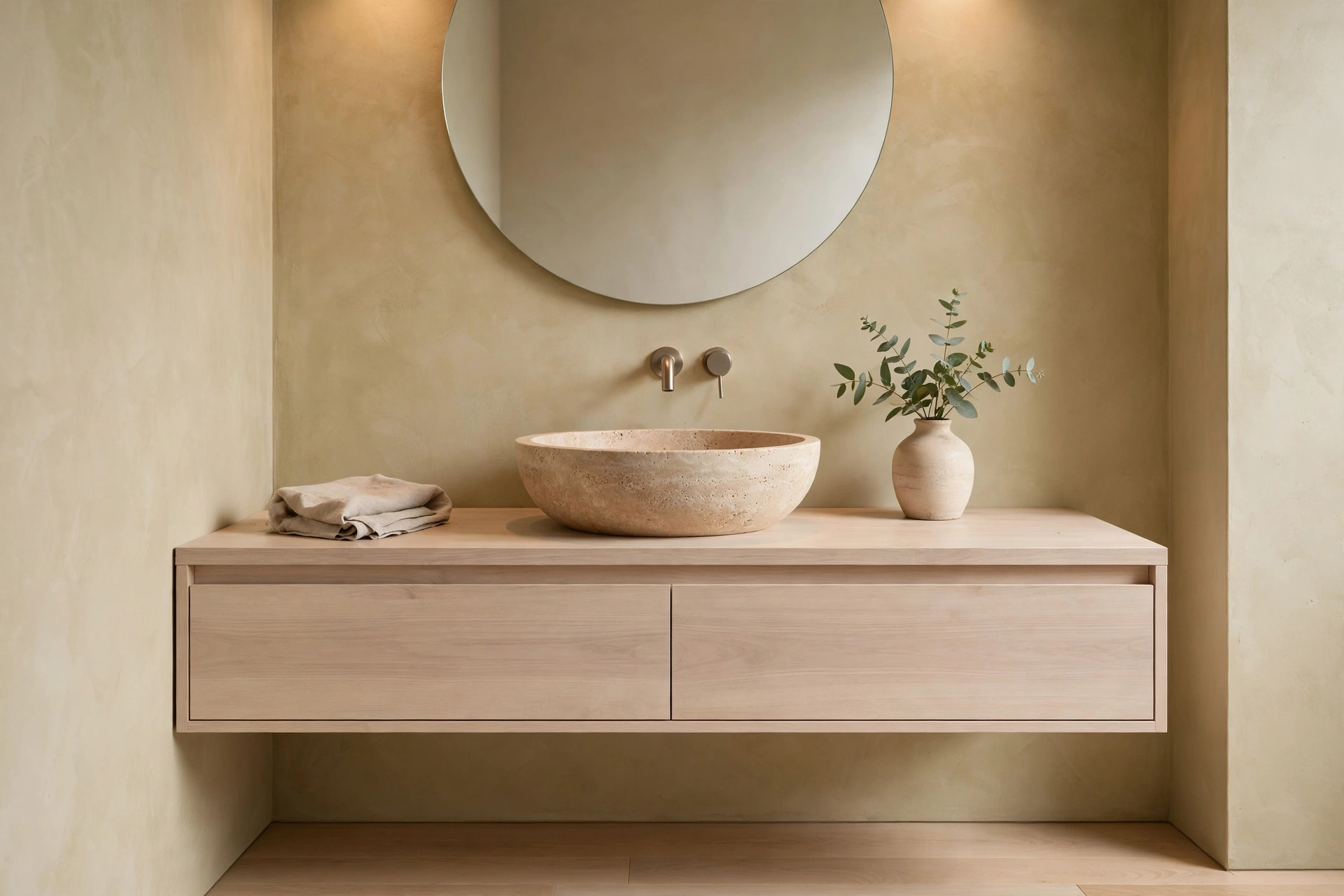
Stone brings the Japanese reverence for nature into the room. Travertine, limestone, honed marble, and slate-look tiles all suit Japandi bathrooms, especially in matte or honed finishes rather than high polish. A stone vessel basin, a travertine-look tiled wall, or large-format stone-effect floor tiles instantly give the room that grounded, spa-like feeling.
Texture matters as much as the material itself. Limewash or clay-plaster-look walls, handmade-look zellige-style tiles with slight surface variation, pebble or fluted tile details, and brushed or honed finishes all add the tactile richness that keeps a neutral room from feeling flat. The wabi-sabi principle applies here: slight variation and imperfection in a surface is a feature, not a flaw.
Matte Finishes and Soft Textiles
Shine is used sparingly in Japandi design. Matte wall tiles, brushed or matte-black taps, honed stone, and flat-finish cabinetry keep light soft and diffused instead of bouncing harshly around the room. If you love a little reflectivity, confine it to one element — a mirror, or a single glazed accent tile — so it reads as intentional.
Textiles are where the Scandinavian warmth shows up most. Choose bath mats, towels, and shower curtains (if you use one) in natural fibers and muted tones: waffle-weave cotton, stonewashed linen, or bamboo-blend towels in oatmeal, sage, or clay. A wooden bath mat or a simple woven rug can replace a standard bath mat entirely and looks far more in keeping with the style.
- Do: mix textures within the same color family — smooth stone, rough linen, grained wood — for quiet richness.
- Do: choose matte or brushed metal finishes (brass, bronze, matte black) over polished chrome for a softer look.
- Don’t: combine glossy ceramic, polished chrome, and shiny plastic accessories — the reflections alone will undo the calm.
Fixtures and Fittings: Less, But Better
Japandi bathrooms favor fewer, better-chosen fixtures with clean lines and simple silhouettes. Every fixture should earn its place. A freestanding tub with a sculptural curve, a wall-hung toilet that reveals more floor, a floating vanity that makes the room feel larger — each choice serves both beauty and function.
Tubs, Showers, and Basins
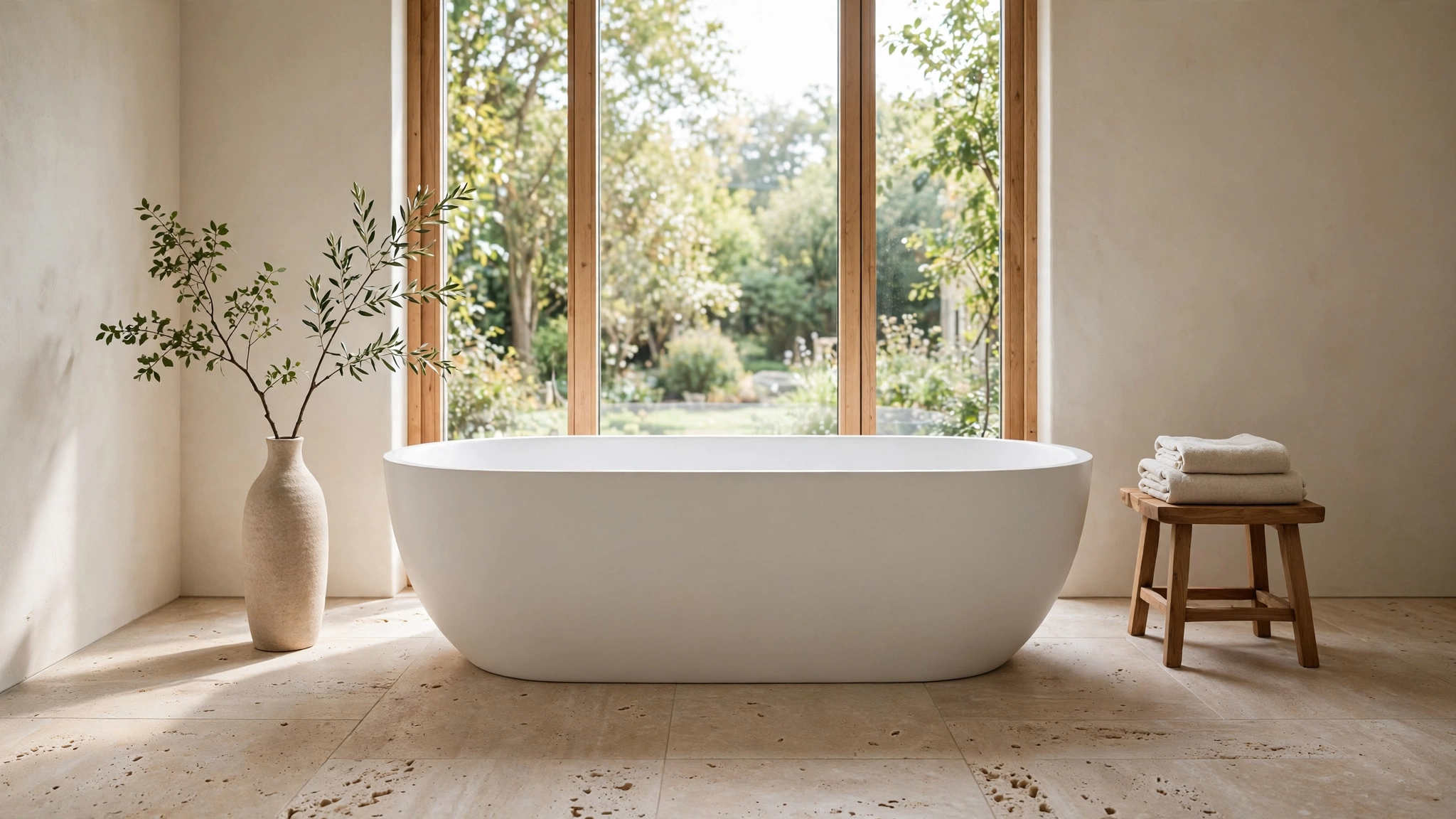
If you have the space, a freestanding soaking tub is the centerpiece of a Japandi bathroom. Look for simple oval or gently curved shapes in matte white solid-surface or stone composite, or a traditional deep Japanese-style tub in wood or wood-look finish for an authentic touch. Position it where it can be enjoyed — near a window if possible — and keep the surround clear so its shape can be appreciated.
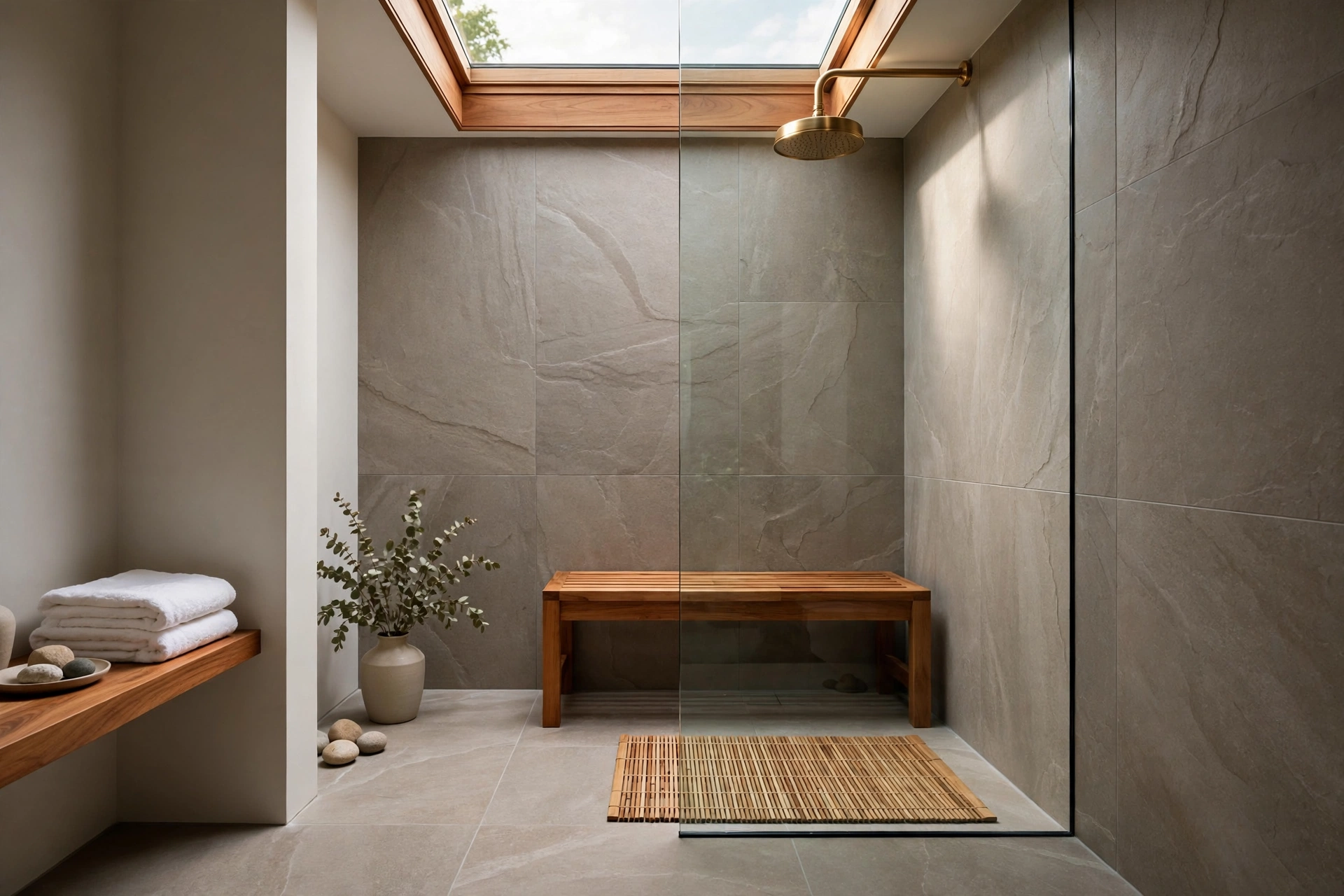
For showers, the Japandi ideal is a walk-in, curbless design with a frameless glass panel (or no panel at all in a wet-room layout), large-format stone-look tiles, and a simple rainfall or wall-mounted shower head. A built-in tiled bench or a teak folding seat adds both function and warmth. Keep grout lines minimal with large tiles, and choose a grout color close to the tile so the surface reads as one calm plane.
Basins in Japandi bathrooms are usually vessel or semi-recessed bowls in stone, stone composite, or handmade-look ceramic — round or softly rectangular, sitting on or into a wood vanity. Wall-mounted taps or tall deck-mounted mixers in a matte finish complete the look and make the basin area easier to wipe down.
Taps and Hardware
Hardware is the jewelry of the bathroom, and in Japandi design it is deliberately understated. Choose simple, architectural shapes — a slim single-lever mixer, a straight wall spout, minimal round or bar cabinet pulls — in brushed brass, matte black, brushed bronze, or brushed nickel. Brushed brass is the classic Japandi choice: warm enough to complement wood, muted enough not to dominate.
Practical tip: Match all your metals throughout the room — taps, shower fittings, cabinet handles, mirror frame, and even the toilet flush plate. Mixed metals (chrome taps with brass handles, for instance) create visual noise that works against the style. Pick one finish and commit to it everywhere.
Lighting a Japandi Bathroom
Lighting can make or break a Japandi bathroom. The goal is soft, warm, layered light that flatters both the materials and the people in the room — bright enough for morning routines, dim enough for an evening soak.
Layered, Warm, and Dimmable
Plan three layers of light. First, general illumination: a ceiling light or recessed spots in a warm color temperature (around 2700K, never cool blue-white). Second, task lighting at the mirror: wall sconces or a backlit mirror at face height on both sides if possible, which lights the face evenly without harsh shadows. Third, ambient or accent light: a small lamp on a shelf, LED strip under a floating vanity, or candles for bath time.
Natural light is the best light of all, so maximize it. Frosted or fluted glass gives privacy without blocking daylight, and a skylight over a shower can transform the whole room. If your bathroom has no window, mimic daylight with high-quality warm-white lighting and a large mirror to bounce it around.
Paper or fabric pendant lights and lanterns are a beautiful Japandi signature — a nod to Japanese shoji screens that diffuses light softly. Hang one over a freestanding tub or in place of a standard ceiling fixture, keeping it well clear of direct water spray and choosing a model rated for bathroom humidity.
- Do: put bathroom lights on dimmers wherever possible — one switch can take the room from morning-bright to evening-calm.
- Do: use warm-white bulbs (2700K) throughout; cool white makes wood look gray and skin look tired.
- Don’t: rely on a single harsh overhead light — it flattens the room and creates unflattering shadows at the mirror.
Storage and Decluttering the Japandi Way
A calm bathroom is, above all, a clutter-free bathroom. Japandi storage is generous but invisible: deep drawers, tall cabinets, and closed doors that swallow the everyday chaos of bottles and brushes, leaving surfaces clear.
Hidden Storage Ideas
A floating vanity with deep, full-extension drawers is the workhorse of Japandi bathroom storage. Drawers beat doors because you can see and reach everything inside. Add drawer organizers or simple wooden boxes so small items don’t slide into a jumble. A tall, narrow linen cabinet in light wood holds towels and spares while echoing the vanity’s material.
Use the often-wasted spaces: a mirrored medicine cabinet recessed into the wall gives generous storage without protruding; the area above the toilet can hold a slim closed cabinet; a toe-kick drawer under the vanity can store cleaning supplies. The rule is simple: if you use it daily, it should have a dedicated, closed home within arm’s reach.
Practical tip: Do a “bottle audit” before you finalize storage. Gather every product you actually use, discard the expired and the nearly-empty, and plan drawer space around what remains. Most people discover they need far less storage than they thought — which is very Japandi.
Beautiful Open Storage
Not everything needs to be hidden. A few well-chosen open storage pieces add warmth and personality: a wooden ladder shelf for folded towels, woven seagrass baskets for rolled washcloths or toilet paper, a small oak stool holding a plant and a candle. The key is curation — open shelves should display a handful of beautiful, useful things, not the entire contents of your medicine cabinet.
Decant where it makes sense. A handmade ceramic tray corralling hand soap and a small vase looks intentional; five mismatched plastic bottles do not. You don’t need to decant everything — just the items that live permanently on display near the basin or bath.
Styling: Plants, Texture, and Wabi-Sabi
Styling is what turns a well-designed bathroom into a Japandi bathroom. This is the layer of living things, handmade objects, and natural texture — added last, and kept deliberately sparse. In Japandi styling, empty space is not wasted space; it is what lets each object breathe.
Plants are almost essential. They add life, softness, and a touch of green to the neutral palette, and many thrive in bathroom humidity. Good choices include ferns, pothos, snake plants, eucalyptus stems in a vase (no soil needed), and small potted herbs. One medium plant in a handmade ceramic or stone pot beats five tiny pots scattered around — think statement, not collection.
Beyond plants, style with a short list of beautiful, useful objects: a wooden bath bridge across the tub, a stone soap dish, a linen towel folded with care, a single branch in a tall vase, a candle or two. Each piece should be something you would happily pick up and hold. If an accessory doesn’t pass that test, it doesn’t belong on display.
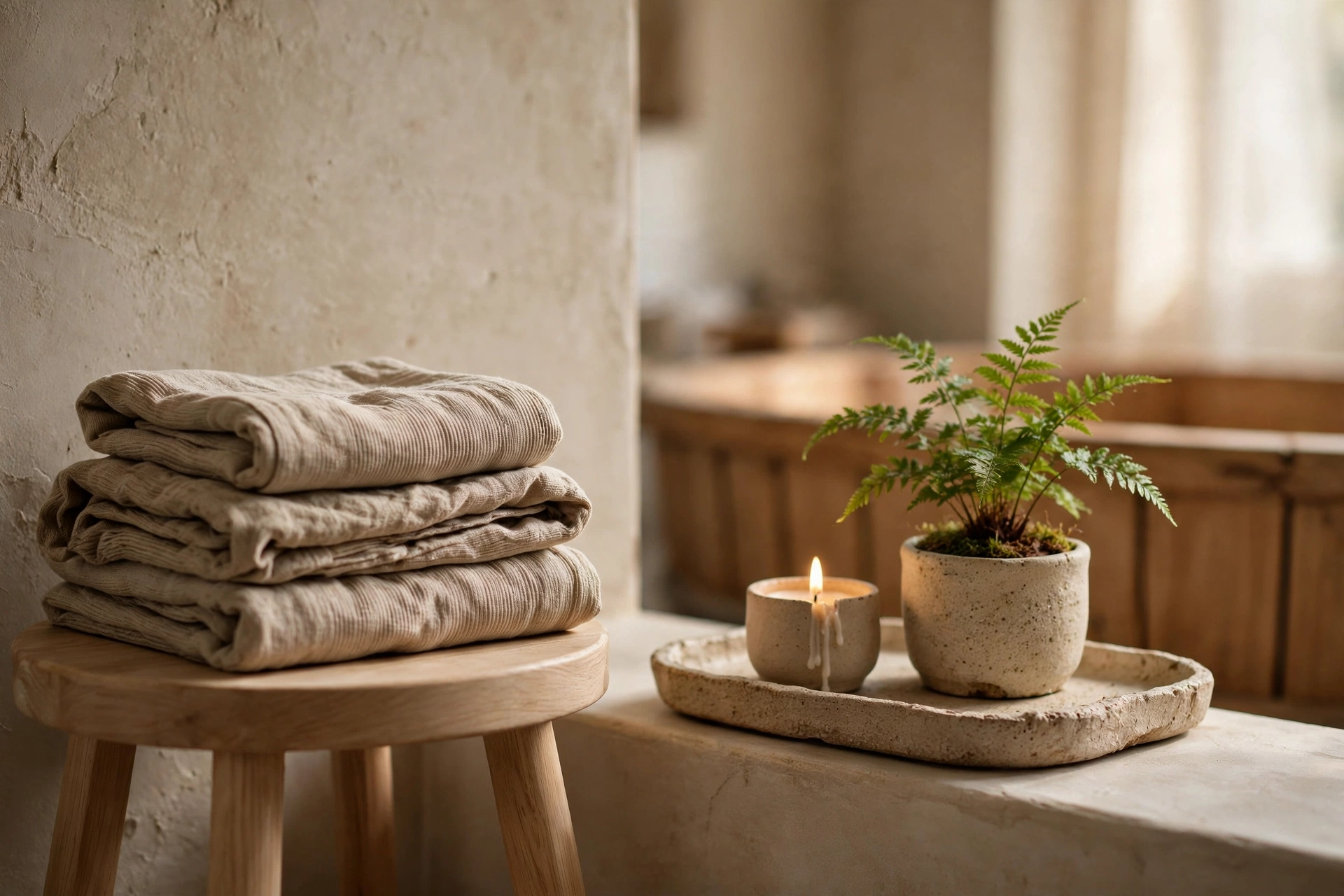
- Do: leave generous empty counter space — a clear surface is the ultimate Japandi accessory.
- Do: choose handmade or hand-finished pieces where you can; slight irregularity is the wabi-sabi signature.
- Don’t: fill every shelf and corner. If you’re unsure whether to add something, leave it out for a week and see if you miss it.
Japandi Ideas for Small Bathrooms
Japandi might have been invented for small bathrooms. Its light palette, clean lines, and clutter-free ethos are exactly what compact spaces need to feel open and calm rather than cramped.
Layout Tricks for Tight Spaces
Wall-hung fixtures are your best friends: a floating vanity and wall-hung toilet reveal more floor, which the eye reads as more space. A curbless walk-in shower with a single glass panel keeps sightlines open across the whole room. In very small bathrooms, consider a compact deep soaking tub instead of a standard long bath — Japanese-style deep tubs are shorter but deeper, giving a luxurious soak in a smaller footprint.
Keep the layout simple and the circulation clear. Avoid breaking a small bathroom into fussy zones with half-walls or busy tile borders; one continuous floor material and one wall treatment throughout makes the room feel like a single serene volume.
Visual Tricks That Add Air
A large mirror — or a mirrored wall section — doubles the sense of space and light. Light colors on walls, floor, and ceiling blur the boundaries of the room. Vertical wood slats draw the eye upward and add warmth without bulk. And ruthless decluttering matters most of all in a small room: in a compact Japandi bathroom, every visible object should be beautiful or essential, preferably both.
Practical tip: In a small bathroom, choose one “moment” — a beautiful basin, a slatted wood wall, a striking pendant light — and keep everything else quiet. One focal point gives a small room character; three focal points give it chaos.
Common Japandi Mistakes to Avoid
Even with the best intentions, it’s easy to miss the mark. Here are the mistakes that most often pull a bathroom away from true Japandi calm:
- Going too cold. All-white everything with gray tile and chrome reads as clinical, not Japandi. Warmth — from wood, warm neutrals, and soft textiles — is non-negotiable.
- Too many materials. Five different tiles plus two wood tones plus patterned wallpaper is maximalism in disguise. Limit the room to three or four materials total.
- Ignoring the “lived-in” layer. A bathroom with no plant, no candle, no folded towel looks like a showroom. Japandi needs a few warm, human touches.
- Open storage overload. Open shelves full of mismatched bottles are the opposite of calm. Hide the everyday, display only the beautiful.
- Cool lighting. Blue-white downlights will undo every warm material choice in the room. Warm 2700K light, on dimmers, always.
- Chasing perfection. Ironically, a bathroom that looks too perfect misses the wabi-sabi point. Let the handmade bowl be slightly uneven; let the wood show its grain.
Your Japandi Bathroom Plan: Step by Step
Feeling inspired but not sure where to start? Work through these steps in order, whether you’re renovating fully or refreshing gradually.
- Define your palette. Choose one warm neutral for walls, one for floors, one wood tone, and one muted accent. Write them down and check every later decision against this list.
- Plan storage first. Before picking a single pretty fixture, decide where everything you own will live behind closed doors. Storage is the skeleton of a calm bathroom.
- Choose fixtures with clean lines. Tub or shower, basin, toilet, taps — simple shapes, one metal finish, matte where possible.
- Layer the lighting. General, task, and ambient light, all warm and dimmable, plus as much natural light as you can get.
- Add wood and texture. Vanity, shelving, stool, bath mat, textiles — this is where the warmth arrives.
- Style sparingly. One plant, a few handmade pieces, folded linens. Then stop, live with it for a week, and only then decide if anything is missing.
- Maintain the calm. Build a five-minute reset into your routine: surfaces cleared, towels folded, bottles back in drawers. A Japandi bathroom stays calm because its owner keeps it that way.
Japandi bathroom design is ultimately less about a shopping list and more about a mindset: choose fewer things, choose them well, and give them room to breathe. Do that, and your bathroom becomes what it was always meant to be — a quiet, restorative pause in the middle of a busy day.
Frequently Asked Questions
What is Japandi bathroom design?
Japandi bathroom design blends Japanese minimalism with Scandinavian warmth. It combines clean lines, natural materials like light wood and stone, a warm neutral palette, and clutter-free storage to create a calm, spa-like bathroom that feels both simple and cozy.
What colors work best in a Japandi bathroom?
Warm neutrals form the base — warm white, beige, oatmeal, and light greige — with light wood tones adding natural warmth. Muted accents like sage green, clay, soft terracotta, or charcoal can be used sparingly for towels, a painted vanity, or small accessories.
Can I create a Japandi bathroom on a budget?
Yes. The style is more about editing than spending. Start by decluttering and hiding toiletries behind closed doors, then add affordable warmth: a wooden bath mat or stool, linen-look towels in neutral tones, a plant, warm light bulbs on a dimmer, and a handmade-look soap dish or tray. Paint is one of the cheapest transformations — a warm off-white instantly softens a cold bathroom.
What kind of wood is best for a Japandi bathroom?
Light woods with a soft grain suit the style best: white oak, ash, beech, birch, and bamboo. In wet areas, use properly sealed or oiled finishes rated for bathrooms, keep wood well ventilated, and consider wood-look porcelain tiles for floors. Teak is a classic choice for shower benches and bath accessories because it handles moisture well.
Does a Japandi bathroom suit a small space?
Absolutely — Japandi is ideal for small bathrooms. The light palette, wall-hung fixtures, frameless glass, and strict decluttering all make compact rooms feel larger and calmer. One continuous floor material, a large mirror, and a single focal point (like a beautiful basin or slatted wood wall) work especially well in tight spaces.
How do I keep a Japandi bathroom looking calm day to day?
Give everything a closed home — deep vanity drawers, a linen cabinet, a mirrored cabinet — and build a short daily reset into your routine: clear surfaces, fold towels, return bottles to drawers. Decant the few items that stay on display into matching or handmade containers, and resist adding new accessories unless something leaves.
What’s the difference between Japandi and regular minimalism in a bathroom?
Minimalism focuses on having less; Japandi focuses on having the right things. A purely minimalist bathroom can feel cold and stark, while Japandi adds Scandinavian warmth (wood, textiles, soft light) and Japanese wabi-sabi (handmade, imperfect, natural materials). The result is a bathroom that is simple but still feels human, warm, and inviting.


