

15 Kitchen Lighting Ideas
There's something magical about a kitchen that glows just right. You know the feeling — that warm wash of light over the island where everyone's gathered, the soft under-cabinet glow that makes your countertops look like they're lit from within, the pendant that makes you smile every time you walk in. Lighting is the jewelry of the kitchen: it takes an ordinary cooking space and turns it into the heart of the home. And the best part? You don't need a full renovation or an electrician on speed dial to get that effect. From statement pendants to clever little upgrades like stick-on LED strips and smart bulbs, these 15 kitchen lighting ideas will help you layer light beautifully — so your kitchen looks gorgeous in the morning rush, cozy at dinner, and downright dreamy after dark. Pin your favorites and start with just one! Even a single lighting change can completely transform how your kitchen feels, and most of these ideas are weekend-friendly projects you can tackle without any major renovation.

1. Oversized Island Pendants
Nothing anchors a kitchen island quite like two or three oversized pendants hanging in a row. Go bigger than you think — shades around 14 to 18 inches wide fill the visual space without crowding it. Hang them 30 to 36 inches above the countertop so they don't block sightlines across the kitchen. Brass, black, or glass shades all work; pick a finish that echoes your cabinet hardware for a pulled-together look. Add dimmer switches and you'll use them all day — bright for homework and meal prep, low and moody for late-night tea. For a long island, stick to odd numbers (three is the sweet spot) and space them evenly so the rhythm feels intentional, not crowded. If your ceilings are low, look for semi-flush oversized designs that give the same bold presence without hanging too deep into the room.
2. Under-Cabinet LED Strip Lighting
Under-cabinet lighting is the single biggest bang-for-your-buck upgrade in any kitchen. Warm-white LED strips (look for 2700K to 3000K) tucked beneath your wall cabinets wash your counters in a soft glow that makes food prep easier and the whole kitchen feel instantly more expensive. Choose plug-in or battery-operated strips if you can't hardwire, or have an electrician tie them to a wall switch during any small remodel. Mount the strip toward the front of the cabinet underside so the light spills down the backsplash rather than disappearing behind it. It's task lighting, ambiance lighting, and a nighttime night-light all in one. For an extra-polished look, add a slim aluminum channel with a diffuser over the strip — it hides the individual LED dots and gives you one smooth, continuous ribbon of light.
3. Statement Chandelier Over the Dining Nook
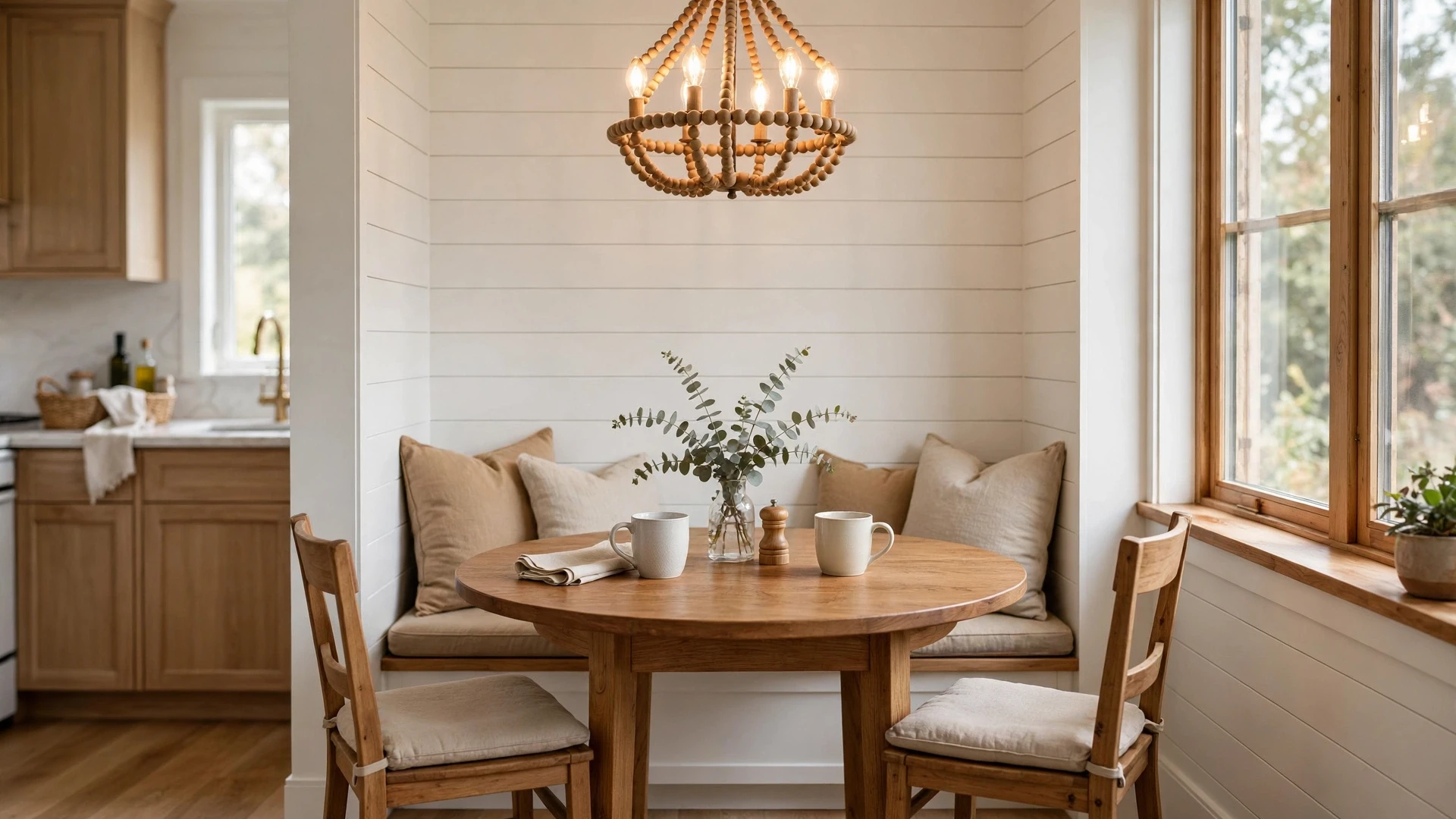
If your kitchen has an eat-in nook or breakfast area, treat it like a tiny dining room with a real chandelier. A beaded, drum, or open-frame chandelier hung 30 to 34 inches above the table sets the nook apart from the cooking zone and makes everyday breakfasts feel a little bit special. Keep the scale proportional — the fixture should be about half to two-thirds the width of your table. Warm bulbs are a must here; nobody wants cool blue light over their pancakes. This one move creates a "room within a room" and is endlessly pinnable. To tie the nook to the rest of the kitchen, echo one finish from your main fixtures — matching brass, black, or wood tones keeps the two zones feeling like family instead of strangers.
4. Recessed Downlights on Dimmers
Recessed can lights are the workhorse of kitchen lighting, and a dimmer makes them feel anything but boring. Space 4-inch or 6-inch recessed lights about 3 to 4 feet apart across the ceiling, positioning them so they wash down onto countertops rather than landing behind you (which casts your own shadow on your work). Put them on a dimmer — or better, split them into zones so the island row, the perimeter, and the sink area can be controlled separately. Cool, even illumination for cooking; dialed-down warmth for evenings. It's the invisible layer that makes every other fixture shine. Pro tip: use adjustable gimbal-style recessed trims over artwork, open shelves, or a coffee bar so you can aim accent light exactly where you want it — one fixture type doing double duty.
5. Glass Pendants That Keep Things Airy
In smaller kitchens or spaces with low ceilings, clear or seeded-glass pendants give you the jewelry-box look without visually cutting the room in half. Because you can see through them, they don't chop up sightlines the way solid shades do, so a small kitchen still feels open. Pair them with warm Edison-style LED bulbs for a cozy sparkle, and consider a trio of mini pendants instead of one large one over a narrow island. Wipe the glass every few months — kitchen grease loves to dull the shine, and a quick polish keeps them looking crystal clear. Clear glass also shows off pretty filament bulbs, so treat the bulb as part of the decor: a warm, visible filament turns the whole pendant into a little piece of glowing art.
6. Sconces Flanking the Range Hood
Wall sconces on either side of the range hood are a designer trick that instantly makes a kitchen look custom. They add warm, flattering light right where you cook and create a beautiful symmetry around the hood — the natural focal point of the kitchen. Choose shaded or upward-facing sconces so the light bounces softly rather than glaring into your eyes, and have them switched separately from the overheads so you can leave just the sconces on for evening ambiance. Brass or matte black finishes coordinate effortlessly with most hood styles, from farmhouse to modern. Keep the sconce scale modest — 8 to 12 inches tall is plenty — so they read as jewelry flanking the hood rather than competing with it for attention.
7. Toe-Kick Lighting for a Floating Effect
Toe-kick lighting — slim LED strips tucked into the recess at the base of your cabinets — makes your cabinetry look like it's floating and gives the kitchen an expensive, architectural glow at night. It's also wonderfully practical: leave it on low in the evening and you'll never stumble through a dark kitchen again. Warm 2700K strips on a motion sensor or smart timer turn on automatically at dusk. Installation is simple with peel-and-stick strips and a plug-in driver hidden inside a base cabinet. It's a subtle detail guests always notice but can never quite place. Run the same warm strip along the inside of a glass-front cabinet or pantry toe-kick to carry the glow through the whole kitchen — one consistent light line ties everything together beautifully.
8. Layered Sink Lighting
The sink area is often the darkest spot in the kitchen — your body blocks the ceiling light while you work. Fix it with dedicated sink lighting: a small pendant centered over the sink, a recessed light aimed at the basin, or a wall sconce if there's a window nearby. This focused light makes dishwashing and veggie-chopping safer and far more pleasant, and it highlights a pretty faucet or farmhouse sink as a design moment. If you have a garden window over the sink, keep daytime light maximized with sheer treatments and let your fixture take over after dark. Bonus: a dimmer on the sink light lets you drop it to a soft glow during dinner parties, so the kitchen looks inviting instead of glaringly "work zone" when guests wander in.
9. Vintage-Style Schoolhouse Pendants
Schoolhouse pendants — those classic milk-glass globes — bring timeless charm that works in farmhouse, cottage, and even transitional kitchens. Their opal glass diffuses light beautifully, casting a soft, even glow with zero harsh glare, which makes them ideal over islands and breakfast bars where people sit and chat. Hang two or three in a row for rhythm, or use a single oversized globe over a small table. They pair gorgeously with beadboard, butcher block, and vintage-inspired faucets. Because the style is so classic, they won't feel dated in five years. For a fresh twist, try schoolhouse pendants in a smoky gray or amber glass — same timeless silhouette, but with a little extra personality that feels current without chasing trends. Hang them a touch lower than standard pendants, around 28 to 32 inches above the island, since their diffused glow is gentle on the eyes.
10. Smart Bulbs for Every Mood
Smart bulbs let your kitchen lighting do double duty: bright, energizing daylight (4000K–5000K) for morning cooking, then warm, dimmed-down light (2700K) for dinner and relaxing. Screw them into your existing pendants, cans, or sconces — no rewiring needed. Set schedules so under-cabinet lights fade on at dusk, or group fixtures by zone ("cooking mode" vs. "dinner mode") and control them from your phone or voice. It's one of the easiest ways to get true layered lighting in a kitchen you can't renovate right now, and the wow factor when guests see it is real. Start with just the pendants or the island zone — you don't have to smarten up the whole kitchen at once to feel the difference. Look for bulbs with a high CRI (90+) so colors stay true — your cherry tomatoes and fresh herbs will look as good as they taste.

11. Lantern Pendants for Farmhouse Charm
Lantern-style pendants — open frames in black metal, wood, or brass with candle-style bulbs inside — are the farmhouse kitchen's best friend. They read as both rustic and refined, giving you that collected-over-time feel without any actual antiquing. Hang a pair over the island or a single large lantern over the kitchen table; the open frame means light spills in every direction, so keep the bulbs warm and dimmable. They look especially good against shiplap, exposed beams, or white cabinetry, and their airy frames keep the sightline open across the room. Swap standard bulbs for flicker-style flame bulbs on a dimmer and the lanterns double as candlelight — all the coziness, none of the fire hazard near the stove. Wood-frame lanterns warm up white kitchens beautifully, while black metal frames add contrast against light cabinetry.
12. Picture-Light Style Accent Over Open Shelves
Borrow a trick from art galleries: mount a slim picture light or a short LED bar above your open shelves. It turns your everyday dishes, glassware, and cookbooks into a lit display and adds a warm accent layer the kitchen was missing. Battery-operated picture lights with remotes are renter-friendly and need zero wiring; hardwired versions can join your sconce circuit. Aim the light to graze down the shelf fronts so textures and colors pop. This tiny addition makes open shelving look intentional and styled rather than just storage. It also doubles as a gentle night-light for the kitchen — enough glow to grab a glass of water without flipping on the overheads. Choose a light in a finish that matches your faucet or cabinet pulls, and the whole shelf vignette will look like it was styled by a designer.
13. Drum Shade Pendants for Soft, Even Light
If you love pendants but hate glare, drum shades are your answer. The fabric shade diffuses light up and down softly, eliminating the harsh spotlight effect of bare bulbs — perfect over islands and tables where people gather and linger. Linen and burlap shades lean farmhouse and coastal; crisp white or black drums feel modern and clean. Size the drum generously — 16 to 20 inches wide for an island pendant — and keep the shade's bottom edge at least 30 inches above the counter so it doesn't block conversation across the island. Choose a shade that's open at the top and bottom rather than fully enclosed, so light still washes the ceiling and counter instead of getting trapped inside the drum. Patterned or textured fabric adds subtle visual interest during the day when the light is off and the shade becomes pure decor.
14. Pendant Cluster Over a Small Island
One big pendant not your style? Try a cluster — three to five small pendants hung at staggered heights over a petite island or peninsula. The varied heights create movement and visual interest, and the grouping reads as one intentional installation rather than scattered fixtures. Keep the shades in the same family (all glass globes, all mini domes) with consistent finishes so it feels cohesive, not chaotic. Stagger the drops by 4 to 6 inches and center the whole cluster over the island. It's a boutique-hotel look that's surprisingly easy to pull off. If your ceiling box is a single junction, use a multi-port canopy — it fans one electrical point out to all five pendants with no extra wiring needed. Keep the total visual weight balanced: petite shades in a cluster read light and playful, so they're perfect for smaller kitchens that can't carry one massive fixture.
15. Dimmers Everywhere (The Secret Weapon)
Here's the truth designers whisper: the fixture matters less than the control. Putting every kitchen light on a dimmer — pendants, cans, sconces, under-cabinet strips — is the cheapest way to get that layered, magazine-worthy glow. Full brightness for cooking and cleaning; half light for dinner; a low warm shimmer for late-night snacks. Dimmer switches cost little and an electrician can swap them in quickly, or use smart dimmers and bulbs for a no-wire option. Once you've lived with dimmers, a kitchen with only on/off switches feels like a flashlight — harsh and one-note. Check that your LED bulbs are labeled dimmable before you buy (not all are), and pair them with an LED-compatible dimmer switch to avoid any flicker or buzz. Start with the fixtures you touch most — island pendants and under-cabinet strips — and you'll wonder how you ever lived with plain on/off.
Styling Tips
Start with three layers in every kitchen: ambient (recessed cans or a flush-mount for overall light), task (under-cabinet strips, sink and range lighting for work zones), and accent (pendants, sconces, toe-kick glow for mood and beauty). If a kitchen feels flat, it's almost always missing one of these layers — usually the accent.
Stick to one color temperature throughout, ideally warm white between 2700K and 3000K, so every fixture flatters the others. Mixing cool and warm bulbs in the same sightline is the fastest way to make a kitchen feel off, even if nobody can name why.
Match your fixture finishes to your hardware family — brass pendants with brass pulls, matte black sconces with a black faucet — and limit yourself to two metal finishes max for a calm, cohesive look. And always, always put lights on dimmers or smart controls; flexibility is what turns good lighting into great lighting.
Finally, think about sightlines: pendants should hang high enough to talk under (30–36 inches above the island, 30–34 above a table), and glass or open-frame fixtures keep small kitchens feeling spacious. Step back to the doorway and look — if the lights draw your eye in a pleasing rhythm, you've nailed it.
FAQ
How many pendant lights do I need over a kitchen island?
For most islands, two pendants suit a 5- to 6-foot island and three suit anything 7 feet or longer. Space them evenly — roughly 24 to 30 inches apart — and keep each pendant's width proportional to the island. When in doubt, fewer and larger beats more and tiny.

What color temperature is best for kitchen lighting?
Warm white in the 2700K–3000K range is the sweet spot for most kitchens — it flatters food, wood tones, and skin. Use the same temperature across all visible fixtures so the light feels unified. If you do detailed cooking or have a very modern white kitchen, 3500K can work, but avoid going cooler than that in living spaces.
How high should pendants hang above a kitchen island?
Hang the bottom of the pendant shade 30 to 36 inches above the countertop. Over a dining table, go slightly lower at 30 to 34 inches above the tabletop. Anyone 6 feet tall should be able to see under the fixtures comfortably without ducking.
Can I add under-cabinet lighting without rewiring?
Yes — peel-and-stick LED strips and puck lights come in battery-operated and plug-in versions that need no electrician. Battery puck lights with remotes are the easiest weekend upgrade; plug-in strips offer brighter, more even light if you have an outlet nearby. For a permanent, switch-controlled setup, an electrician can hardwire them in under an hour or two.
What's the difference between task, ambient, and accent lighting?
Ambient lighting is the general overhead light that fills the room (recessed cans, flush mounts). Task lighting is focused light for work areas — under-cabinet strips, sink lights, range-hood lights. Accent lighting is decorative and mood-setting: pendants, sconces, toe-kick glow, shelf lights. Great kitchens layer all three.
Do I need dimmers on all my kitchen lights?
You don't strictly need them, but dimmers are the single most impactful lighting upgrade for the money. They let one set of fixtures serve bright cooking light and cozy evening ambiance. At minimum, put pendants and under-cabinet lights on dimmers — those are the fixtures you'll adjust most.
Conclusion
Great kitchen lighting isn't about buying the most expensive fixtures — it's about layering. Combine practical task light where you chop and cook, warm ambient light that fills the room, and a few beautiful accent pieces that make you happy every time you flip the switch. Start with one idea from this list — under-cabinet strips are the easiest win — and build from there. Your kitchen will feel warmer, work better, and photograph beautifully for all those Pinterest saves. Now go find the glow your kitchen deserves.


