

15 Living Room Bookshelf Styling Ideas
There is something deeply comforting about a living room with a well-styled bookshelf. It tells a story about the people who live there — the novels they cannot put down, the cities they have loved, the little treasures they could not leave behind. A bookshelf is never just storage; it is the most personal piece of furniture in your home, and how you style it can turn an ordinary living room into a space that feels layered, warm, and unmistakably yours.
The secret is that great bookshelf styling is equal parts art and editing. It is about mixing heights, balancing books with breathing room, and weaving in textures and personal objects so the whole thing feels curated rather than cluttered. Whether you have a towering built-in, a simple floating shelf, or a beloved secondhand bookcase, these fifteen living room bookshelf styling ideas will help you transform it into the prettiest corner of your home. Each idea comes with specific, practical details — colors, materials, placement, and pairings — plus a styling tips section and answers to the questions readers ask most.
1. The Color-Coordinated Rainbow Shelf
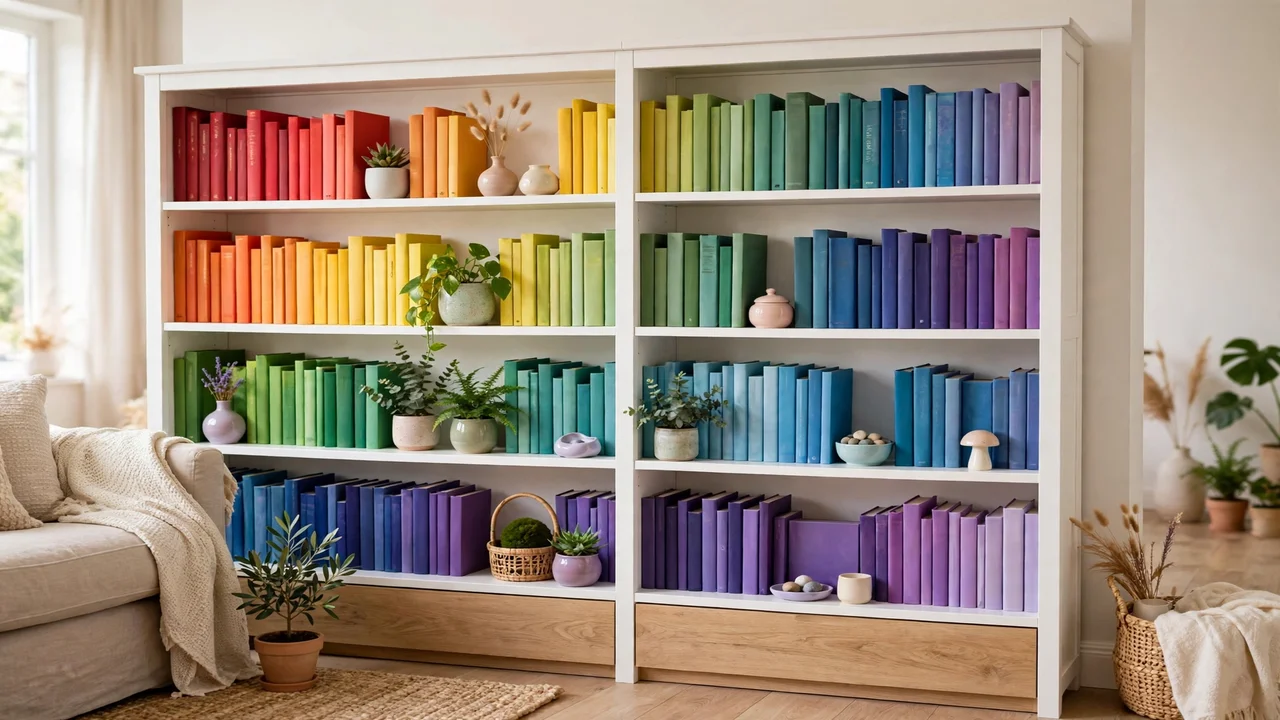
Organizing your books by color creates an instant rainbow that turns your shelf into the room's artwork. This is the boldest bookshelf move you can make, and it works beautifully in a living room with a neutral backdrop. Start by sorting your books into color families — reds, oranges, yellows, greens, blues, purples, neutrals — and arrange them in rainbow order across the shelves, spines facing out.
This look works best when the wall behind the shelf is a soft white or warm greige, so the colors pop without competing. Anchor the display with a cream linen sofa nearby and a natural jute rug underfoot to keep the room from feeling too busy. If full rainbow feels like a lot, try a tonal gradient instead: arrange books from light to dark within one family, like creams fading into honey tones. Leave small gaps between color groups for a mini vase or brass bookend. The result is joyful, playful, and surprisingly sophisticated when the rest of the room stays calm.
2. Warm Minimalist with Generous Breathing Room
Less is truly more with the warm minimalist bookshelf. The rule here is simple: fill only about two-thirds of each shelf with books, and let the remaining third breathe. Space out the books in loose groupings of five to eight, sometimes vertical, sometimes in short horizontal stacks, with empty patches of shelf between them.
Pair pale wood shelving — like white oak or light maple — with warm white walls and books in muted, earthy covers. The emptiness is the design: it makes each object feel important. Tuck in one or two sculptural pieces, such as a handmade ceramic vase in matte cream or a small travertine bowl, spaced well apart. Below the shelf, a low boucle chair and a sheepskin throw keep the palette soft. This style is perfect if your living room already has a lot going on elsewhere — the bookshelf becomes a calm, quiet moment instead of visual noise.
3. Built-In Library Wall with Ladder
Nothing says "dream living room" like a floor-to-ceiling built-in bookcase, and adding a rolling library ladder takes it straight into fantasy territory. Paint the built-ins a rich, enveloping color — deep forest green, warm espresso, or classic navy — so the wall of shelves reads as architecture, not just furniture. The dark paint makes book spines glow against it.
Arrange books in varied stacks: mostly vertical rows, broken up by horizontal piles of three to five topped with a small object. The ladder itself is both functional and decorative — brass hardware on the rail adds a jewelry-like finish. Place a cognac leather armchair angled toward the shelves with a wool plaid throw, and add a floor lamp with a warm-toned shade nearby for evening reading. If your shelves are extra deep, layer framed art leaning against the back panel in front of a row of books. This look anchors large living rooms and makes even an awkward empty wall feel intentional and grand.
4. The Curated Collector's Mix of Books and Objects
This is the styling approach of people whose shelves look like a beautiful museum gift shop: books and objects interwoven with intention. The ratio to aim for is roughly seventy percent books and thirty percent objects — vases, framed photos, small sculptures, candles, travel souvenirs, and houseplants.
Group books both vertically and in horizontal stacks, then place one object on or beside each horizontal stack. Vary the heights dramatically: a tall ceramic vase next to a short stack of art books, a trailing pothos spilling over a shelf edge, a small framed print leaning against the books behind it. Stick to a loose color story — say, warm metals, natural wood, green plants, and cream ceramics — so the variety feels cohesive rather than chaotic. A rust-colored velvet armchair and a brass floor lamp nearby echo the warm metallic accents. Step back often and squint: if any shelf looks cluttered, remove one thing. Editing is the whole game here.
5. Rustic Farmhouse with Natural Textures
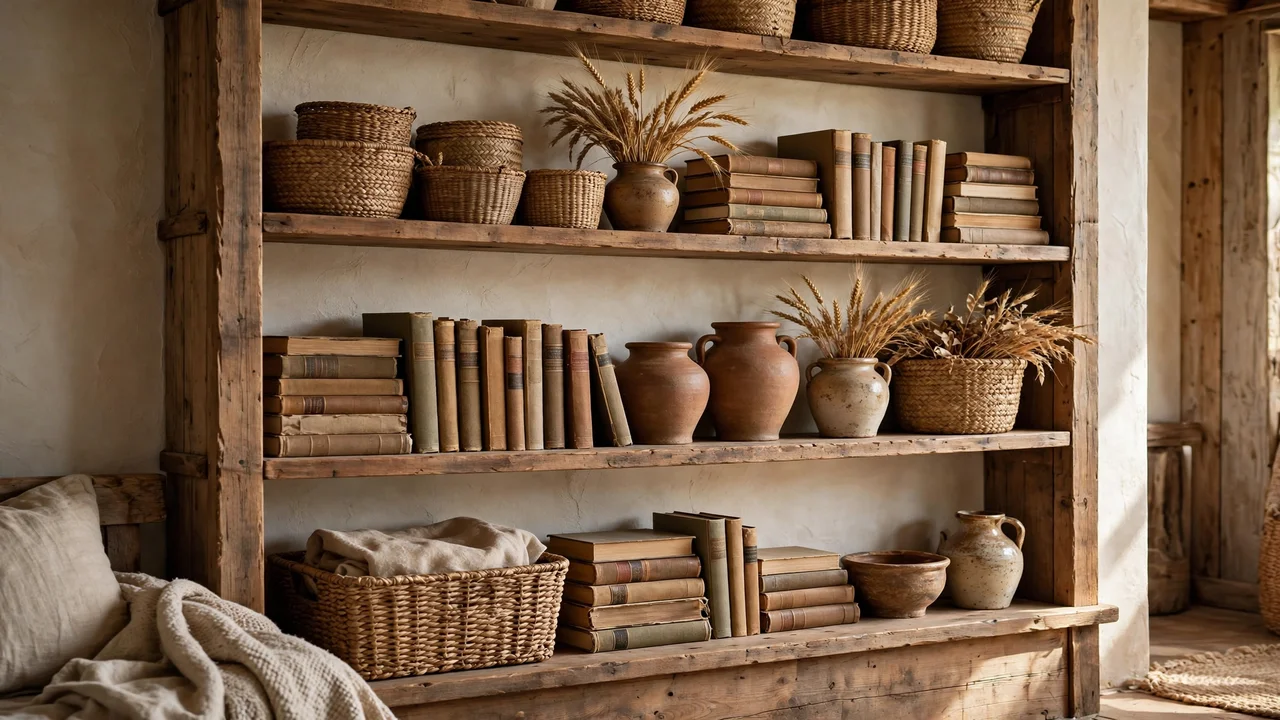
For a cozy farmhouse living room, style your bookshelf as a celebration of natural materials. Choose a chunky wooden bookcase — reclaimed pine, weathered oak, or a warm walnut finish — and fill it with a mix of books and organic decor: woven baskets on the lower shelves, dried eucalyptus in a stoneware jug, a stack of folded linen throws, wooden beads draped over a book stack.
Keep the color palette warm and earthy: creams, oatmeals, sage green, terracotta, and natural wood tones. Fill the lowest shelves with large woven seagrass baskets to hide clutter — remotes, board games, spare blankets — while adding gorgeous texture. Drape a faux olive tree sprig or trailing ivy from an upper shelf for softness. Pair with a plaid wool throw on a nearby sofa and a jute rug underneath. Leave the wood grain visible and a little imperfect; the charm of this look is in its relaxed, lived-in honesty rather than perfection.
6. Moody Dark Shelves for Evening Drama
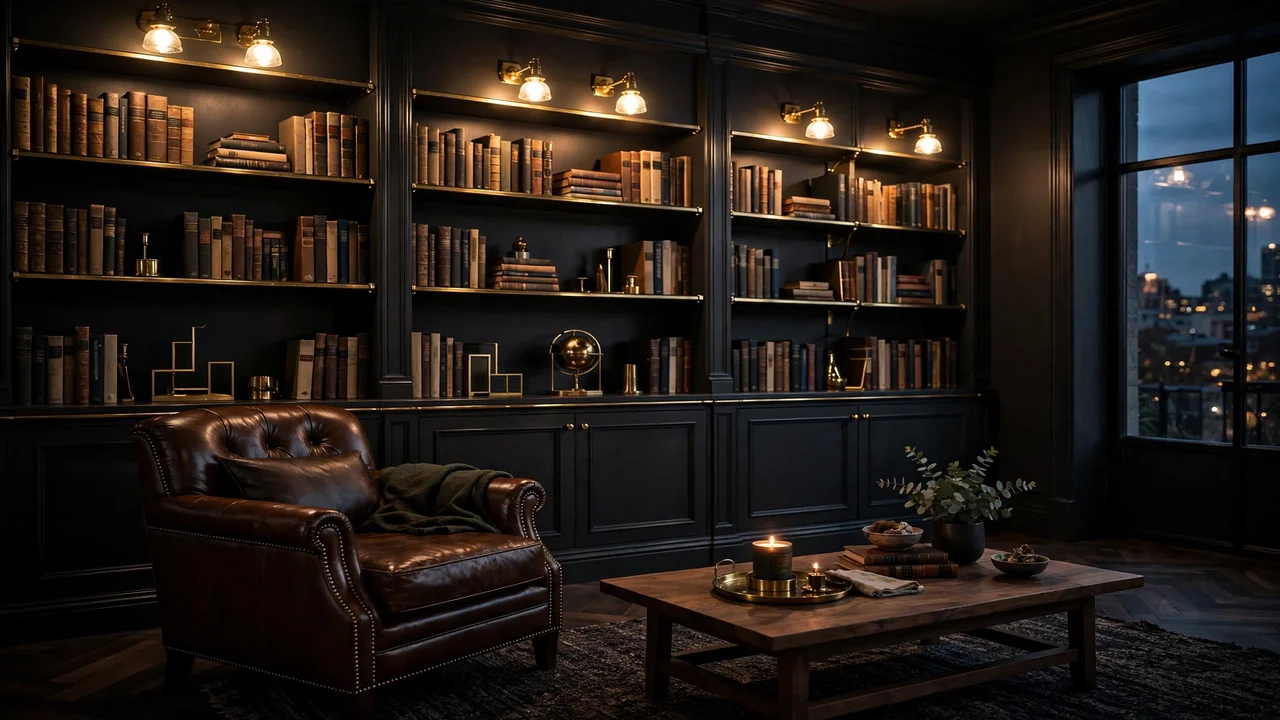
Paint your bookshelves a deep, dramatic color — charcoal black, midnight navy, or dark chocolate brown — and watch your living room gain instant evening glamour. Dark shelves make everything on them look more precious: book spines pop, brass objects gleam, and white ceramics glow like sculpture. This works on both built-ins and freestanding bookcases.
Style with a mix of books, metallic accents, and candlelight. Brass candlesticks, a small gold-framed mirror leaning on a shelf, and amber glass vases catch the light beautifully against the dark backdrop. Keep books in mixed colors rather than color-blocking them — the variety looks rich against the dark paint. Add a velvet emerald or cognac armchair nearby, a faux fur throw, and a dimmable table lamp with a warm bulb so the corner glows at night. Finish with one oversized piece of art above the shelves to complete the gallery feel. This is the bookshelf look for people who love their living room best after sunset.
7. Scandinavian Light and Airy Shelves
Scandinavian bookshelf styling is all about pale wood, white space, and a sense of calm order. Choose a simple light-oak or birch bookcase and style it sparsely: books arranged with breathing room, a few pale ceramic pieces, one small green plant, and lots of visible shelf. The goal is serene, not sparse — every object earns its place.
Group books in small clusters of four to six, alternating vertical rows with single horizontal stacks topped by a tiny object like a smooth stone or a miniature vase. Add texture through materials rather than color: a chunky knit basket, a folded wool throw draped over the side of the bookcase, a small potted fern in a white pot. Keep the palette limited to whites, soft grays, pale woods, and one muted accent — dusty blue or sage works beautifully. Pair with a light gray linen sofa, a round white coffee table, and sheer curtains. The whole corner should feel like a deep breath.
8. Floating Shelves as a Gallery Wall
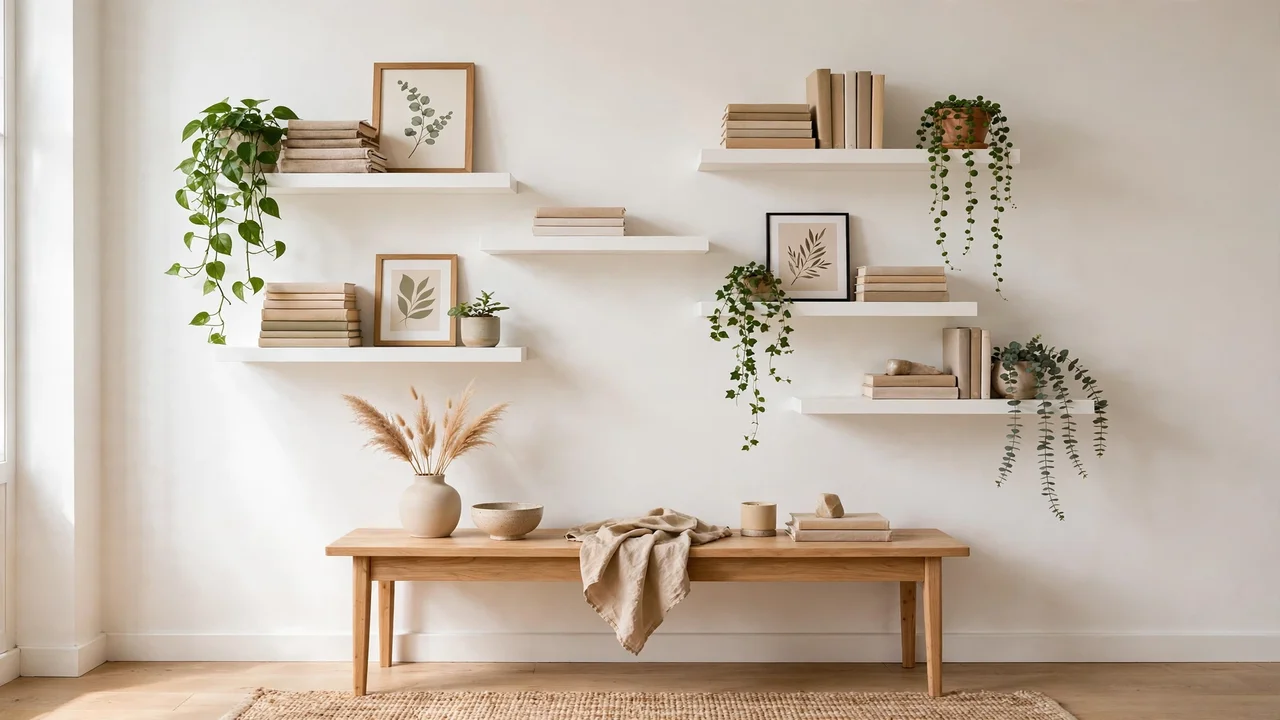
Floating shelves turn your books into a floating art installation. Install two to four long floating shelves on a living room wall — staggered at slightly different lengths looks more dynamic than perfectly matched — and style them like a gallery: books leaning casually, framed prints overlapping, small sculptures, and trailing plants.
Because floating shelves have no sides, keep each shelf's styling low and airy so nothing looks like it might tumble. Use small brass or acrylic bookends to keep leaning books upright. Mix in framed family photos, a small abstract print, a bud vase with a single stem, and a trailing golden pothos or string of pearls that cascades down one end. Paint the wall a soft warm white or very pale sage so the floating arrangement stands out. Below, place a slim console table or a low bench so the wall vignette has a grounded base. This approach is perfect above a reading chair or beside the sofa, turning an empty wall into the room's personality center.
9. Vintage Bookcase with Secondhand Charm
A vintage or thrifted bookcase — with its worn edges, old hardware, and stories of its own — brings soul that new furniture cannot imitate. Lean into the character: do not over-restore it. A gentle clean and maybe a coat of wax is enough. Style the shelves with a mix of old hardcovers (their faded cloth bindings are gorgeous), brass candlesticks, antique picture frames, a small collection of vintage cameras or teacups, and one or two plants.
The magic here is in the mix of eras. Pair the vintage bookcase with a modern linen sofa and a contemporary rug so the room feels curated rather than dusty. Let some shelves hold books stacked horizontally with a vintage find on top — a brass magnifying glass, a stack of old postcards tied with twine, a tiny porcelain bird. Warm lighting is essential: a small table lamp on the top shelf or a picture light above the bookcase makes the wood glow. This look tells guests your home was collected over time, not decorated in a weekend.
10. Symmetrical Twin Bookcases Flanking the Fireplace
Flanking your fireplace with a matching pair of bookcases is one of the most classic, satisfying living room compositions there is. The symmetry instantly makes the room feel balanced and intentional. Choose two identical bookcases — painted built-in style in white or a soft neutral — and style them as near-mirror images, with small variations so they feel human rather than robotic.
On each side, arrange books in the same rhythm: vertical rows on the upper shelves, horizontal stacks with objects on the lower ones. Mirror the big pieces — a tall vase on the left's top shelf, a tall vase on the right's top shelf — but vary the small details, like different framed photos or plants. The fireplace between them becomes the natural focal point, especially with a large mirror or piece of art on the mantel tying the two sides together. This layout works beautifully in traditional and transitional living rooms, giving the whole space a tailored, finished feel that is hard to achieve any other way.
11. The Reading Nook Bookshelf Corner
Turn your bookshelf into the anchor of a dedicated reading corner. Pull a comfortable armchair — a deep club chair, a classic wingback, or an oversized swivel chair in a cozy fabric like corduroy or boucle — up close to a low, wide bookcase, add a floor lamp with a warm reading bulb, and a small side table for tea. The bookshelf becomes the backdrop of your personal retreat.
Keep the books here the ones you actually reach for: current reads, favorites you reread, a stack of design magazines. Style the top of a low bookcase as a surface — a small lamp, a candle, a bud vase — so it doubles as a side table. Add a round braided rug under the chair to define the nook, and hang a small piece of art above it. Choose warm, enveloping colors — terracotta, caramel, deep green — so the corner feels like a hug. Even in a busy open-plan living room, this little zone says "sit down and stay a while."
12. Boho Eclectic with Plants and Woven Texture
The boho bookshelf is joyful, layered, and gloriously full — the opposite of minimalism, but with its own careful logic. Start with a wooden bookcase in a warm medium tone, then layer in plants, woven baskets, macramé, travel souvenirs, candles, and books in every color. Trailing plants are non-negotiable: let a pothos, philodendron, or spider plant spill from the top shelf.
Weave texture through every level: a small woven wall hanging leaning on a shelf, rattan baskets holding books or magazines, a macramé plant hanger hooked to the bookcase side, beaded garlands draped across a horizontal stack. Mix metals freely — brass, copper, and blackened steel all coexist in boho style. Keep the palette warm: terracotta, mustard, rust, teal, and plenty of natural wood and green from the plants. Pair with a low patterned rug, floor cushions, and a rattan chair nearby. The rule is abundance with a color thread — as long as the warm, earthy palette holds, the layers feel collected rather than chaotic.
13. Sleek Modern with Mixed Materials
For a contemporary living room, style a bookshelf that plays with mixed materials: matte black metal framing with warm wood shelves, or a walnut bookcase with smoked glass shelves. The contrast of materials is the design statement, so keep the styling clean and geometric. Arrange books in precise vertical rows, broken by the occasional horizontal stack with a single sculptural object — a matte ceramic vessel, a small abstract sculpture, a geometric bookend.
Limit the color palette to three tones: the shelf materials plus one accent, like warm white ceramics against black metal with books in muted covers. Hide visual clutter — use the lowest shelf or a closed cabinet base for anything utilitarian. Add one oversized element for drama, such as a large leaning art print on the top shelf. Pair with a low-profile sofa in a solid neutral and a single bold area rug. Every object should look chosen; if it does not spark a little joy in its geometry, edit it out.
14. Kids' and Family-Friendly Display Shelves
A family living room bookshelf needs to be beautiful and genuinely usable. Dedicate the lower shelves to the kids: picture books facing forward so covers show (use small plate ledges or forward-facing bins), a basket of building blocks, a row of stuffed animals. Forward-facing books invite little hands and double as colorful decor — children's book covers are little pieces of art.
Style the upper shelves for the grown-ups: your novels and coffee table books, a framed family photo, a small plant placed safely out of reach, a candle on the highest shelf. Use sturdy, forgiving materials — a solid wood bookcase that can handle bumps, washable baskets instead of delicate boxes. Anchor the bookcase to the wall for safety, which is non-negotiable with climbers. Keep the color story cheerful but controlled: let the kids' books provide the color pop while your upper shelves stay in a calmer palette of neutrals, wood, and green. The result is a living room that welcomes the whole family without looking like a playroom took over.
15. Seasonal Refresh: Restyling Shelves Through the Year
The loveliest bookshelf secret is that it does not have to stay the same all year. A seasonal refresh — swapping a few objects while the books stay put — keeps your living room feeling alive and gives you a creative ritual four times a year. In spring, add a vase of fresh tulips and light linen-colored accents. Summer calls for a piece of driftwood, a bowl of shells, and airy, sun-bleached tones.
For fall, tuck in a small pumpkin or two, dried wheat stems in a stoneware vase, and warm amber glass. Winter brings pinecones in a wooden bowl, a strand of warm fairy lights woven along the back of a shelf, and a deep green throw draped nearby. Keep a small storage bin of seasonal shelf decor so the swap takes twenty minutes, not a whole afternoon. The books provide the constant backbone; the seasonal objects are the jewelry you change with the weather. It is the easiest way to make your living room feel new without new furniture.
Styling Tips
Follow the rule of thirds. Mentally divide each shelf into thirds and avoid filling all three. Books in two-thirds, one object or empty space in the remaining third — this single habit prevents the stuffed, cluttered look more than anything else.
Vary heights and orientations. Alternate vertical rows of books with horizontal stacks, and place tall objects (vases, candlesticks) next to short stacks. The eye loves rhythm, and height variation creates it.
Repeat colors, not objects. Pick three to four colors from your room — say, terracotta, cream, warm wood, and green — and echo them across shelves in different forms: a terracotta vase here, a rust-colored book spine there, a plant's green leaves above. Repetition creates cohesion.
Layer from back to front. On deeper shelves, lean a framed print or small piece of art against the back panel, then place books or a horizontal stack in front of it, and finish with a small object at the very front. This creates depth that flat, single-row styling never achieves.
Anchor heavy items low. Big baskets, heavy book stacks, and large decorative boxes belong on the bottom shelves. It looks grounded and keeps tall bookcases stable — especially important in homes with kids or pets.
Leave some shelves nearly empty. One shelf with just a single beautiful object — a sculptural vase, a piece of driftwood, a small stack of art books — gives the whole bookcase room to breathe and makes everything else look more deliberate.
Light it up. A small picture light above the bookcase, battery-operated puck lights on a shelf, or a strand of warm fairy lights along the back panel transforms shelves after dark. Bookshelves look twice as good with dedicated lighting.
Step back and squint. The oldest stylist trick in the book: stand across the room and squint at your shelves. Blurry shapes reveal the balance — if one side looks heavy or one shelf glares bright, you will see it instantly and know what to move.
Frequently Asked Questions
How do I style a bookshelf without it looking cluttered?
The key is restraint plus rhythm. Fill roughly two-thirds of each shelf and leave the rest empty or nearly so. Group books in clusters rather than spreading them edge to edge, alternate vertical and horizontal arrangements, and repeat a small set of colors across the shelves. Every time you add an object, remove something else. If you step back and the shelf feels busy, take away one item per shelf — you will be amazed how much calmer it looks.
Should books be organized by color, size, or subject?
It depends on how you use them. Color organization looks stunning and works well for books you reach for by memory of the cover. Organizing by subject or author is more practical if you actually reference your books often. A happy middle ground: group by subject within loose color families, or color-block just one feature shelf and organize the rest practically. There is no wrong answer — choose the system you will enjoy living with.
What can I put on bookshelves besides books?
Almost anything with a story: framed photos and small art prints, vases and ceramic vessels, candles and candlesticks, houseplants (trailing ones are especially pretty), woven baskets, travel souvenirs, small sculptures, decorative boxes, clocks, and bookends that are beautiful in their own right. The trick is mixing — objects alone look like a gift shop, books alone look like a library, but together they look like home.
How do I style the top of a tall bookcase?
Treat the top as its own mini vignette, but keep it simple since it is seen from a distance. One larger statement piece works best: a big vase with branches, a leaning piece of art, a basket, or a trailing plant spilling over the edge. Avoid lots of small items up there — they read as clutter from across the room. If your ceilings are low, leave the top empty so the bookcase does not feel like it is crowding the ceiling.
How many books should be on each shelf?
There is no magic number, but a good guideline is to fill about sixty to seventy percent of each shelf's width with books, leaving the rest for objects or breathing room. On a standard 36-inch shelf, that is roughly twenty to twenty-five average-sized books in vertical rows, or a mix of a vertical cluster plus one horizontal stack. When in doubt, fewer books styled with intention always look better than shelves packed tight.
How do I make a cheap bookcase look expensive?
Three upgrades make the biggest difference: paint or wallpaper the back panel in a rich color, add warm lighting (puck lights or a picture light), and style with breathing room and repeated colors instead of cramming every shelf full. Solid-looking bookends, a few quality ceramic pieces, and baskets that hide clutter elevate the whole piece. Most people register "expensive" as "intentional" — generous spacing and a cohesive color story do more than any price tag.
Conclusion
A beautifully styled bookshelf is one of the most rewarding projects in a living room — it costs little, uses things you already own, and transforms the whole feel of the space. Start with one idea that speaks to you, whether that is the drama of moody dark shelves or the calm of Scandinavian simplicity, and style just one shelf to begin. You will be surprised how quickly the rest follows. Step back, squint, edit one thing, and enjoy the corner of your home that finally tells your story.


